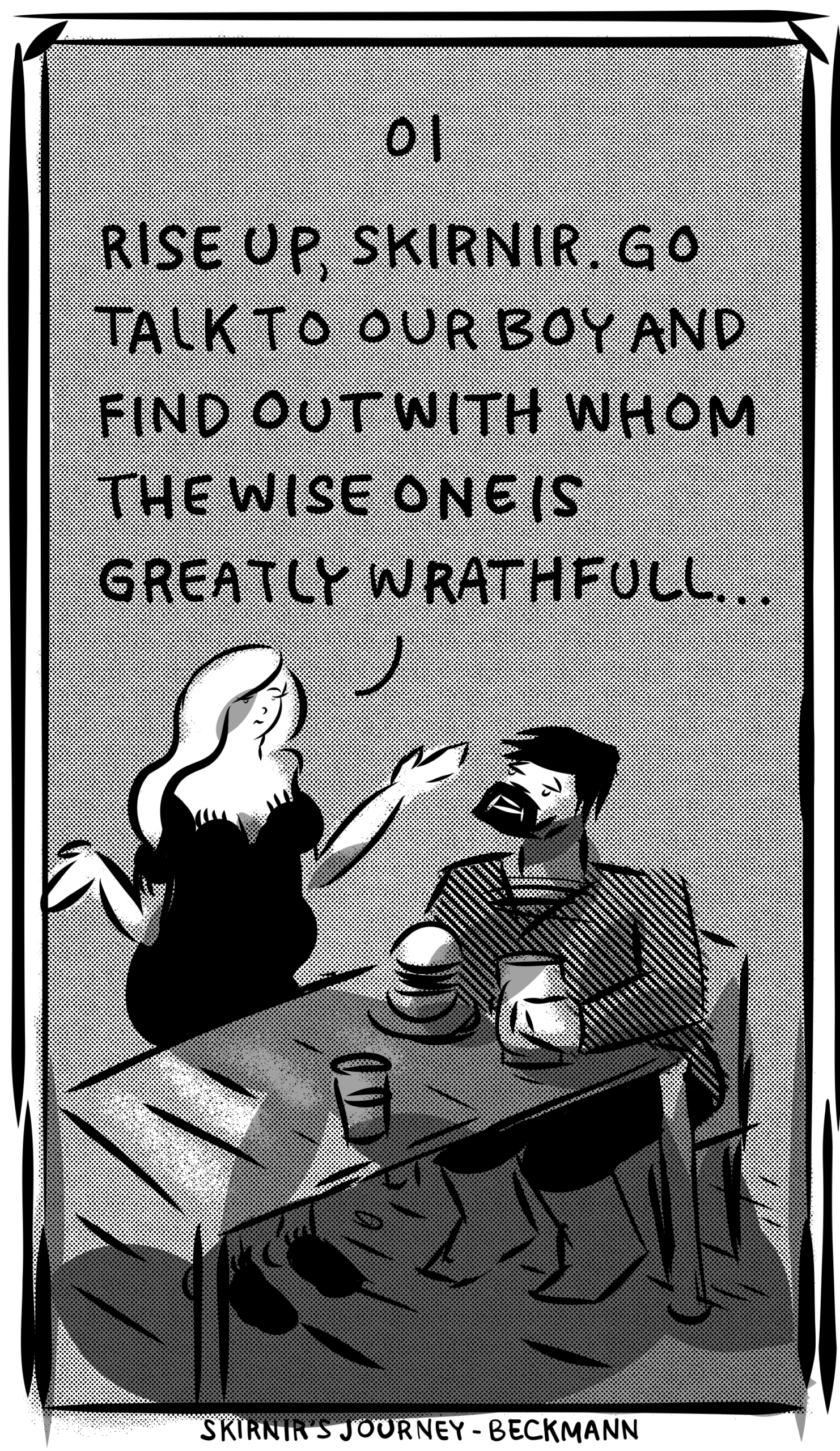
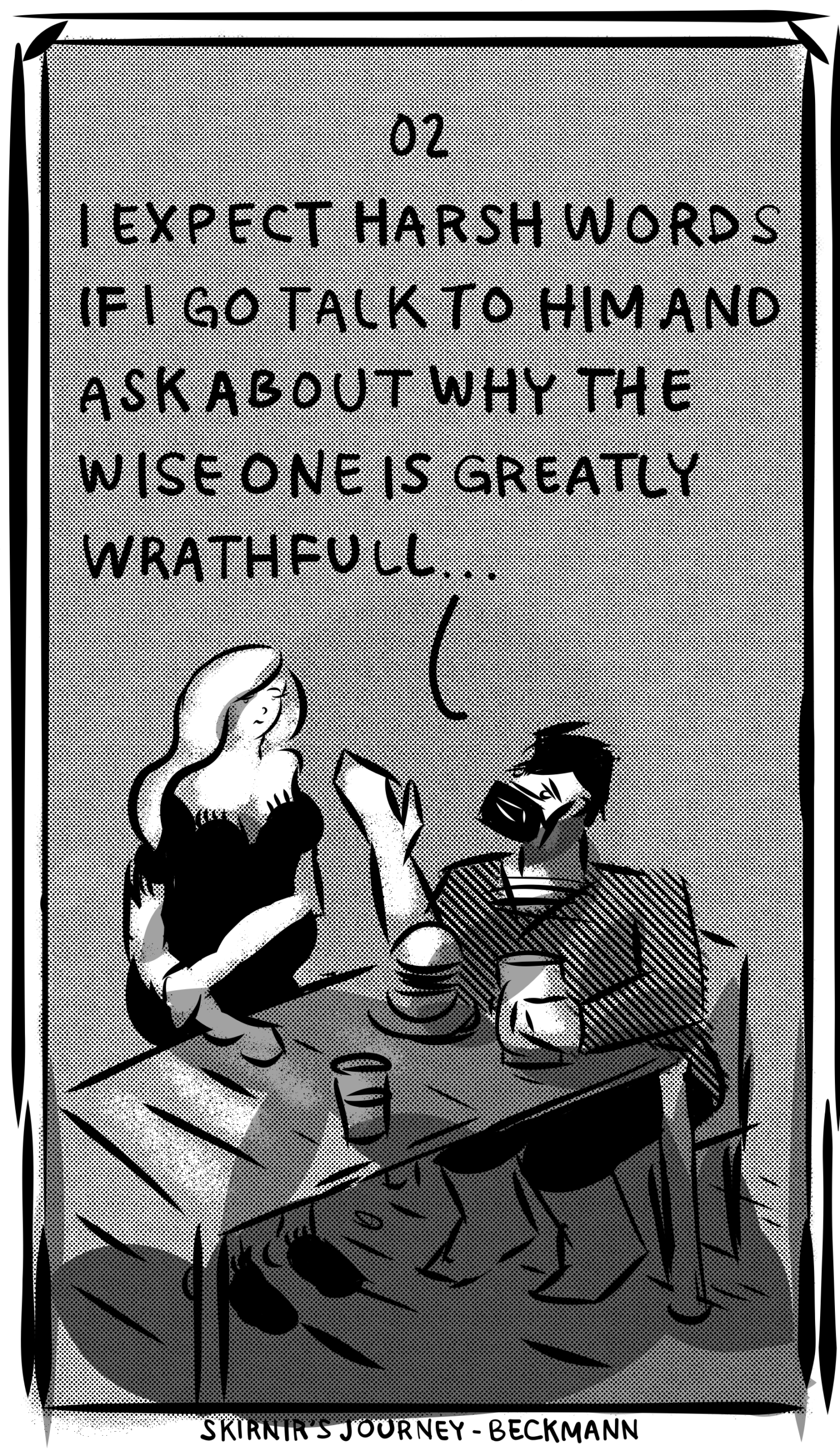
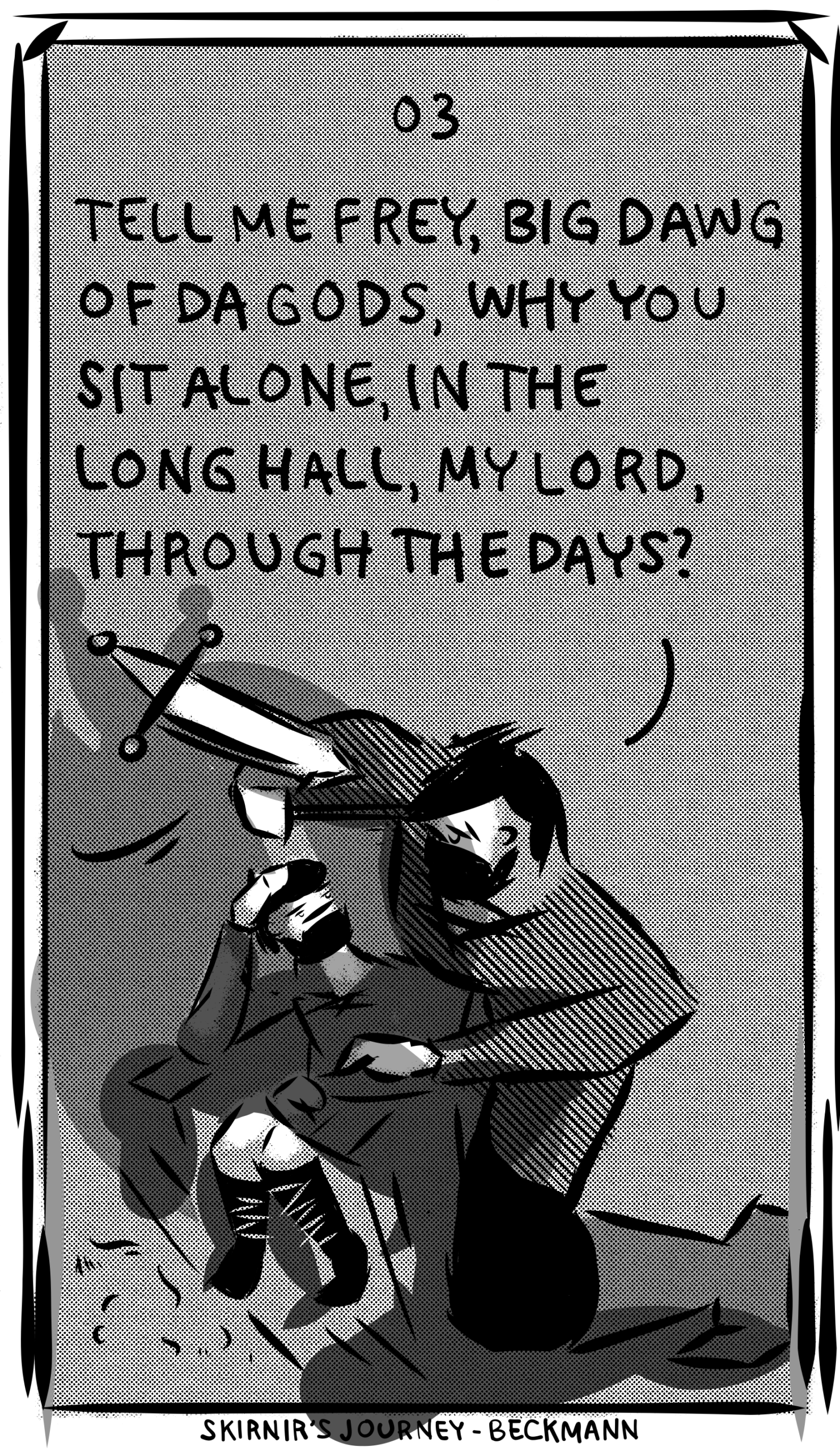
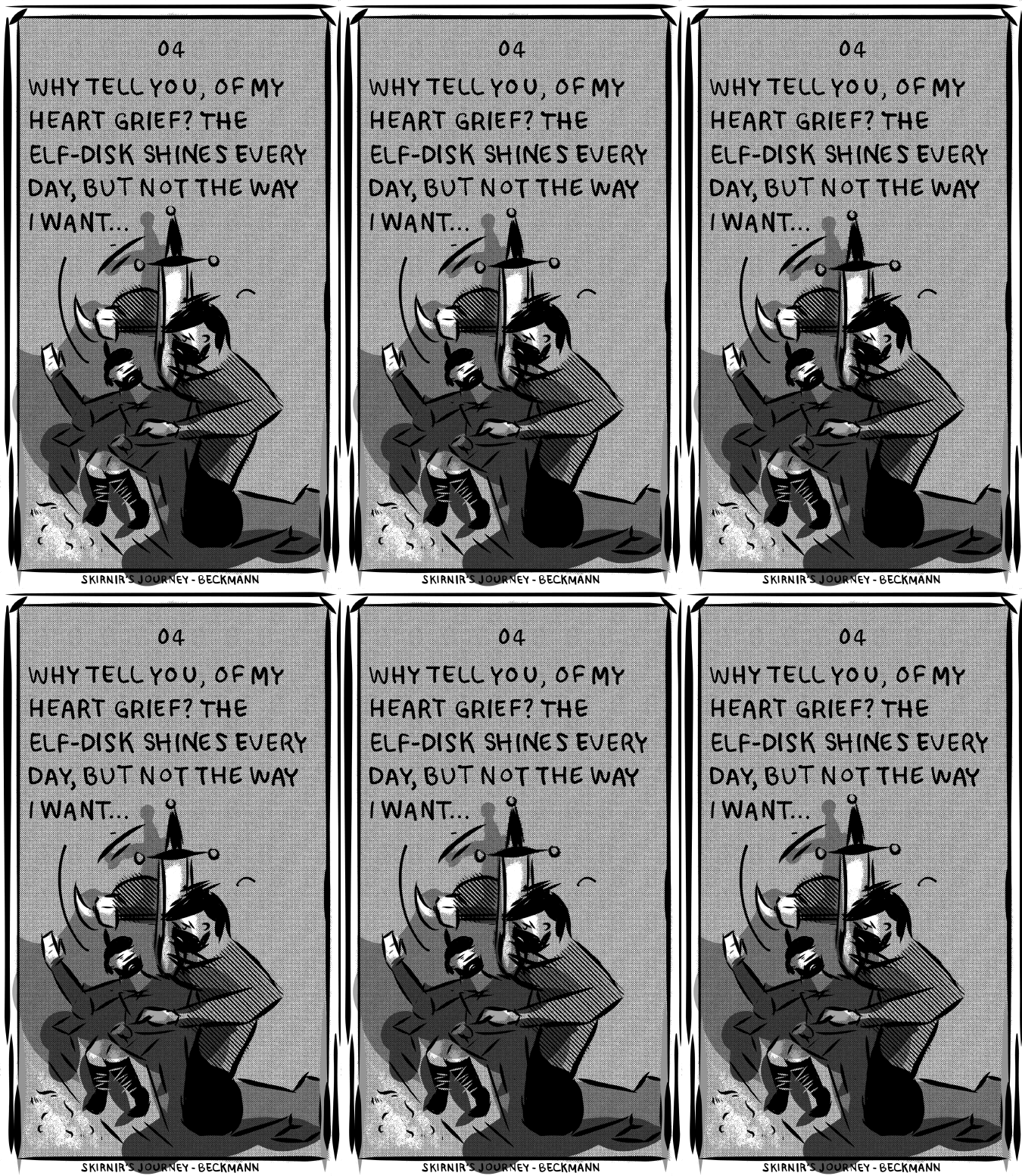
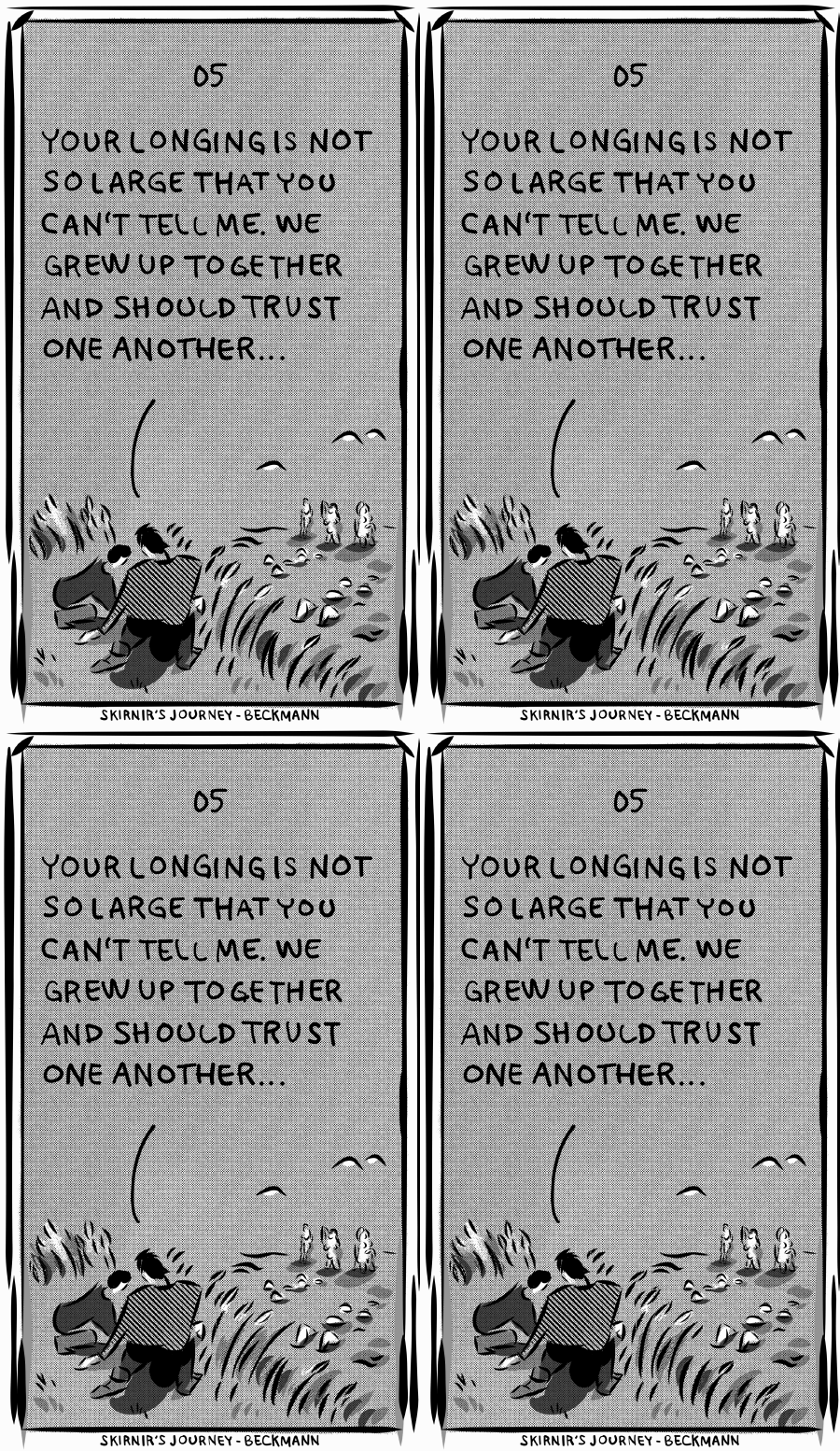
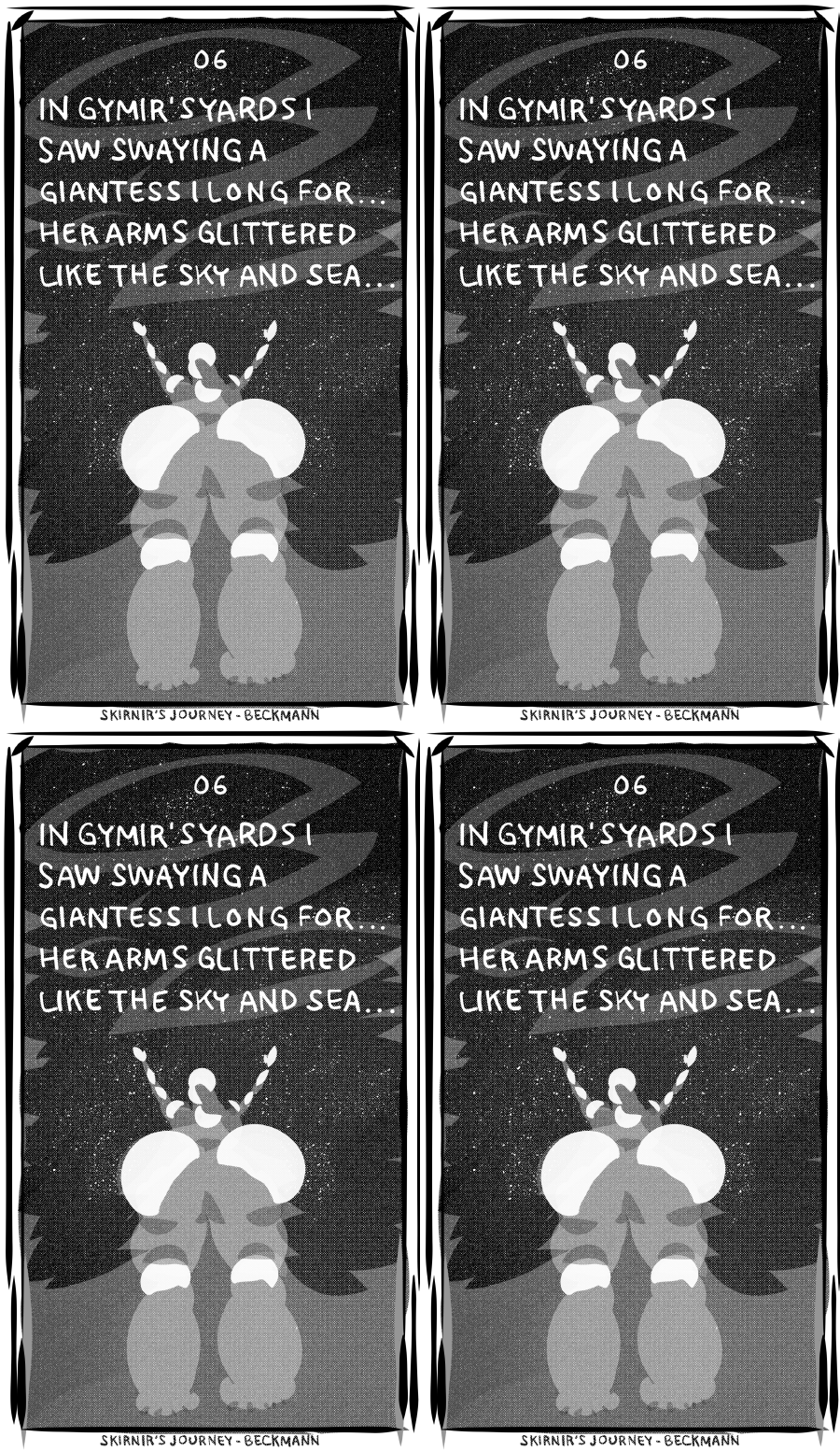
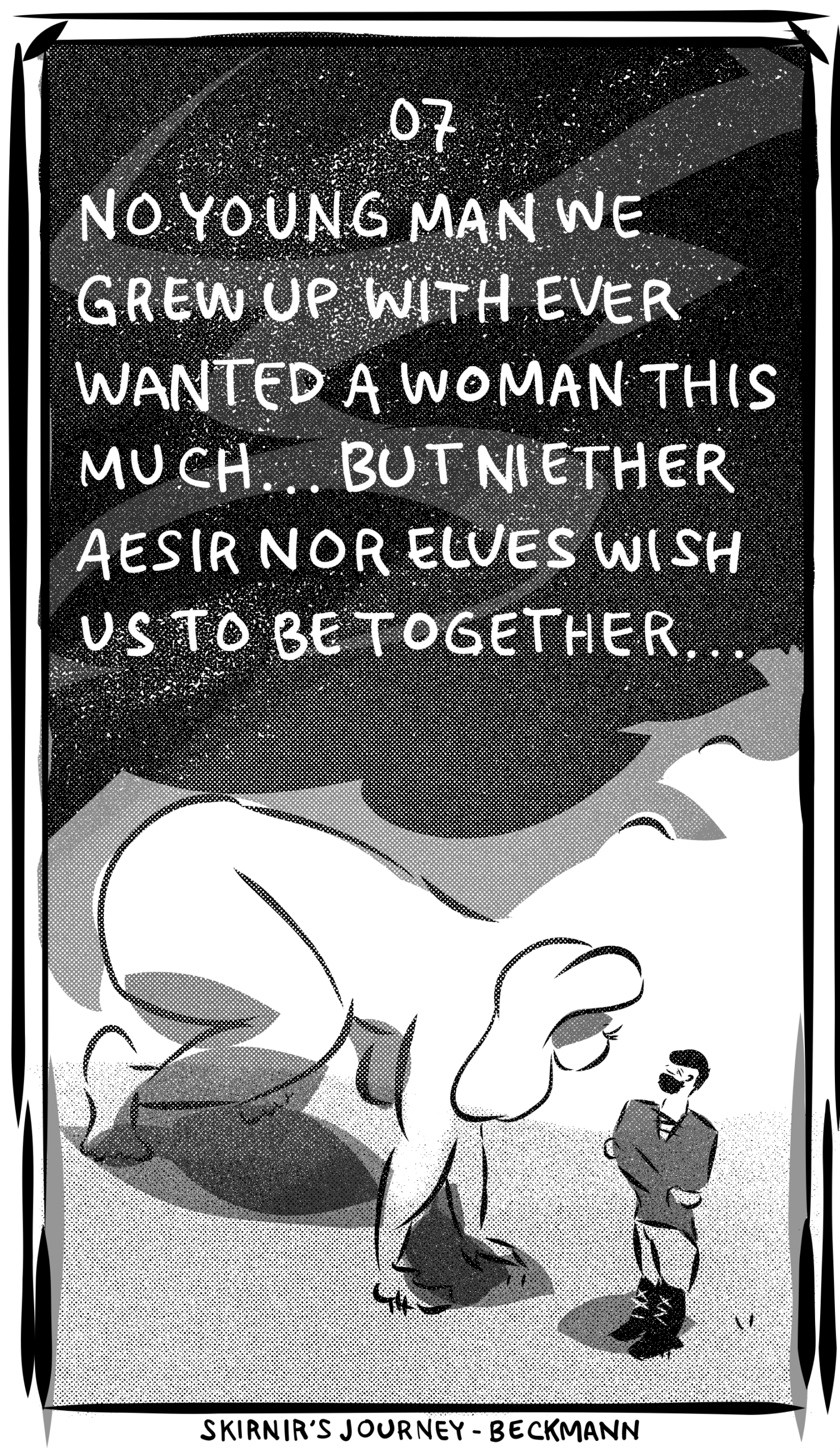
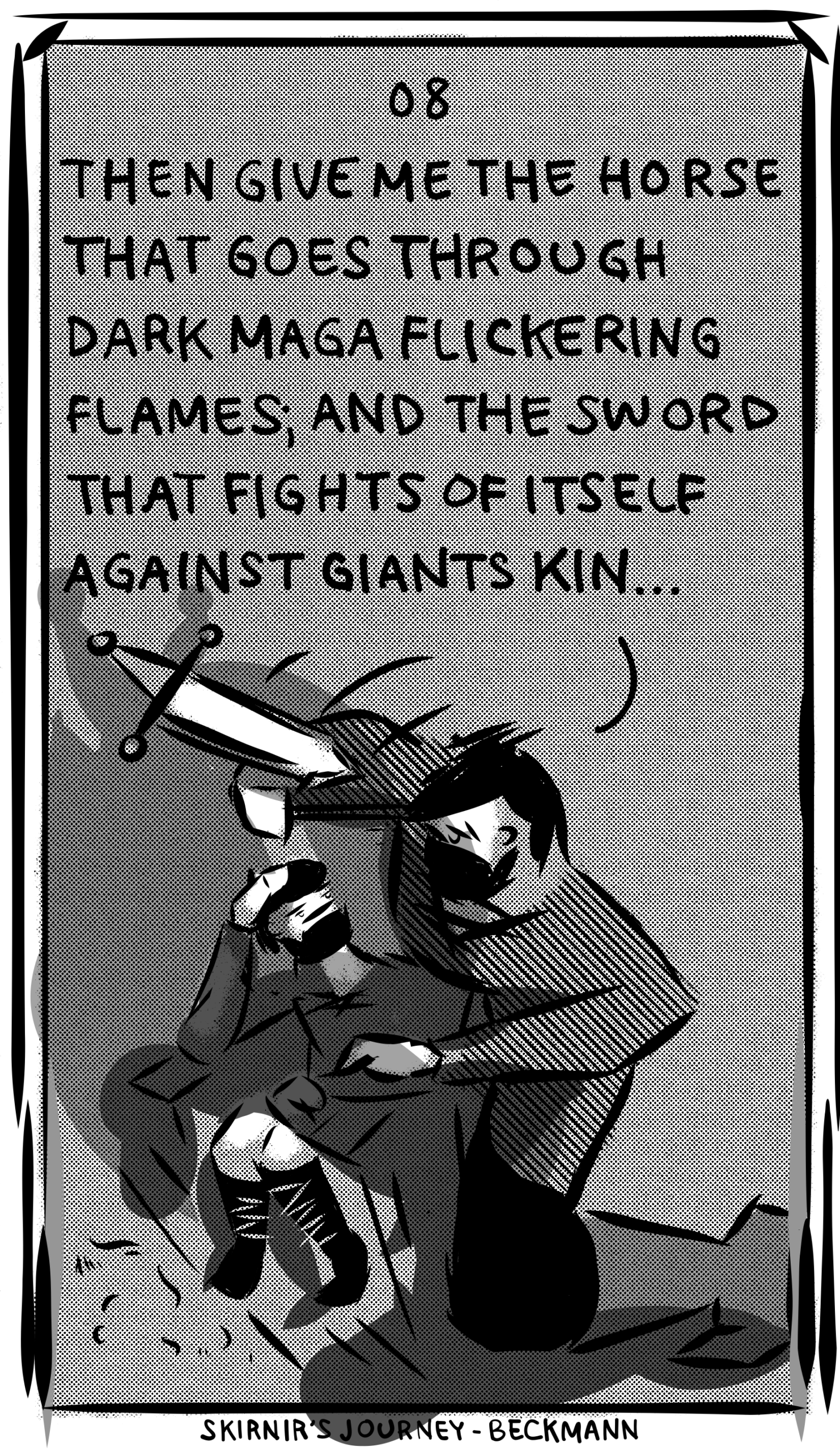
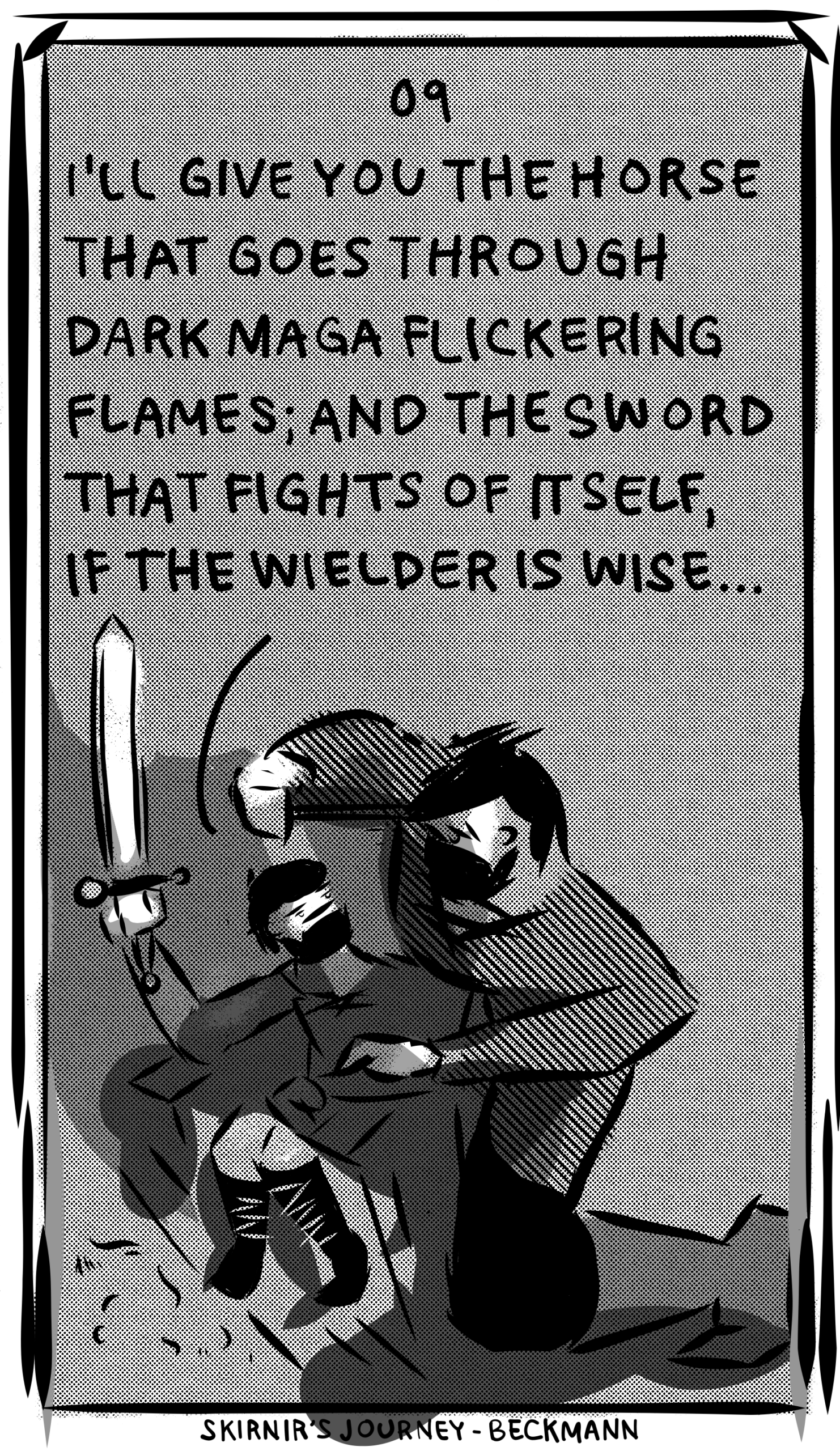
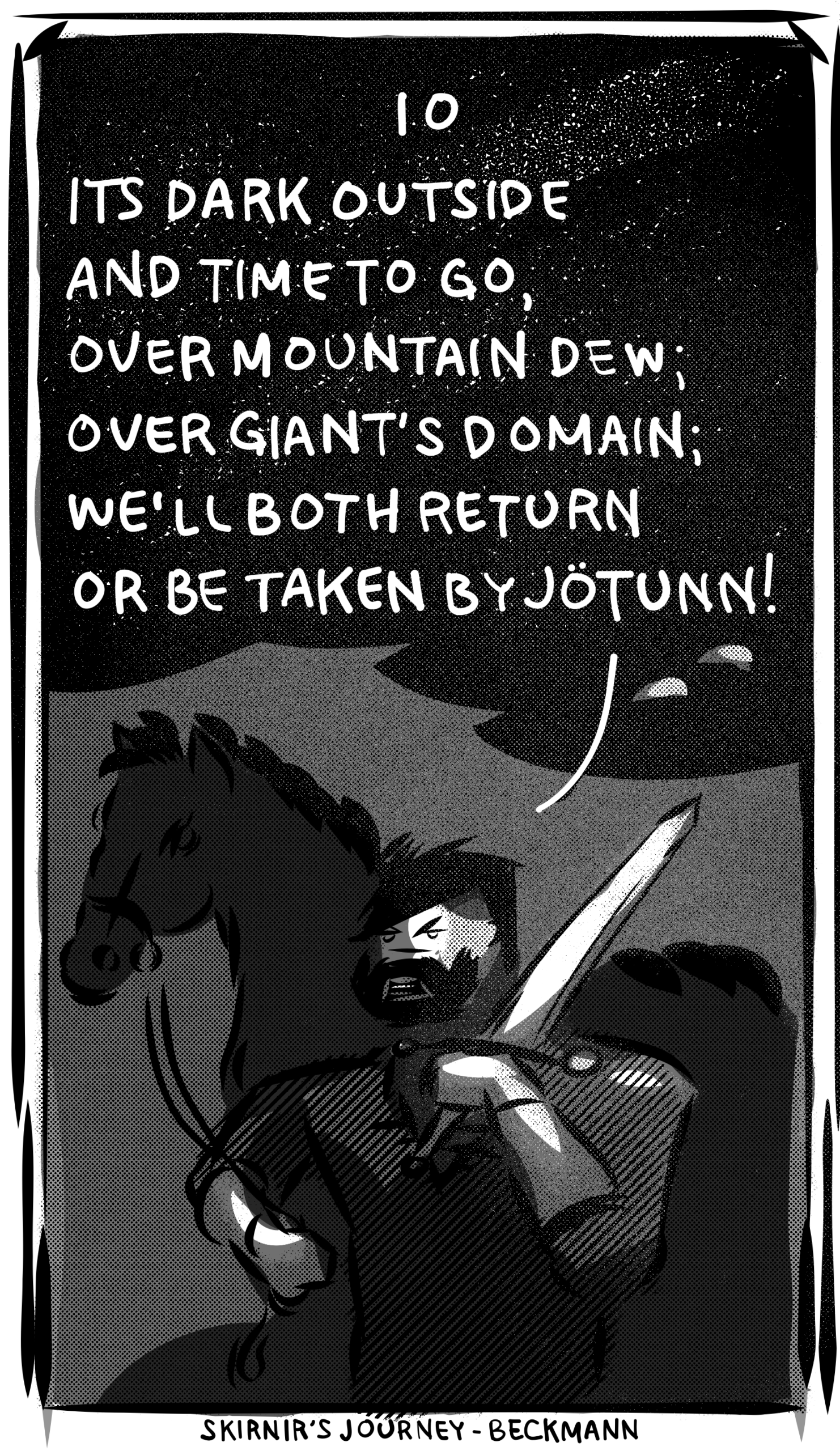
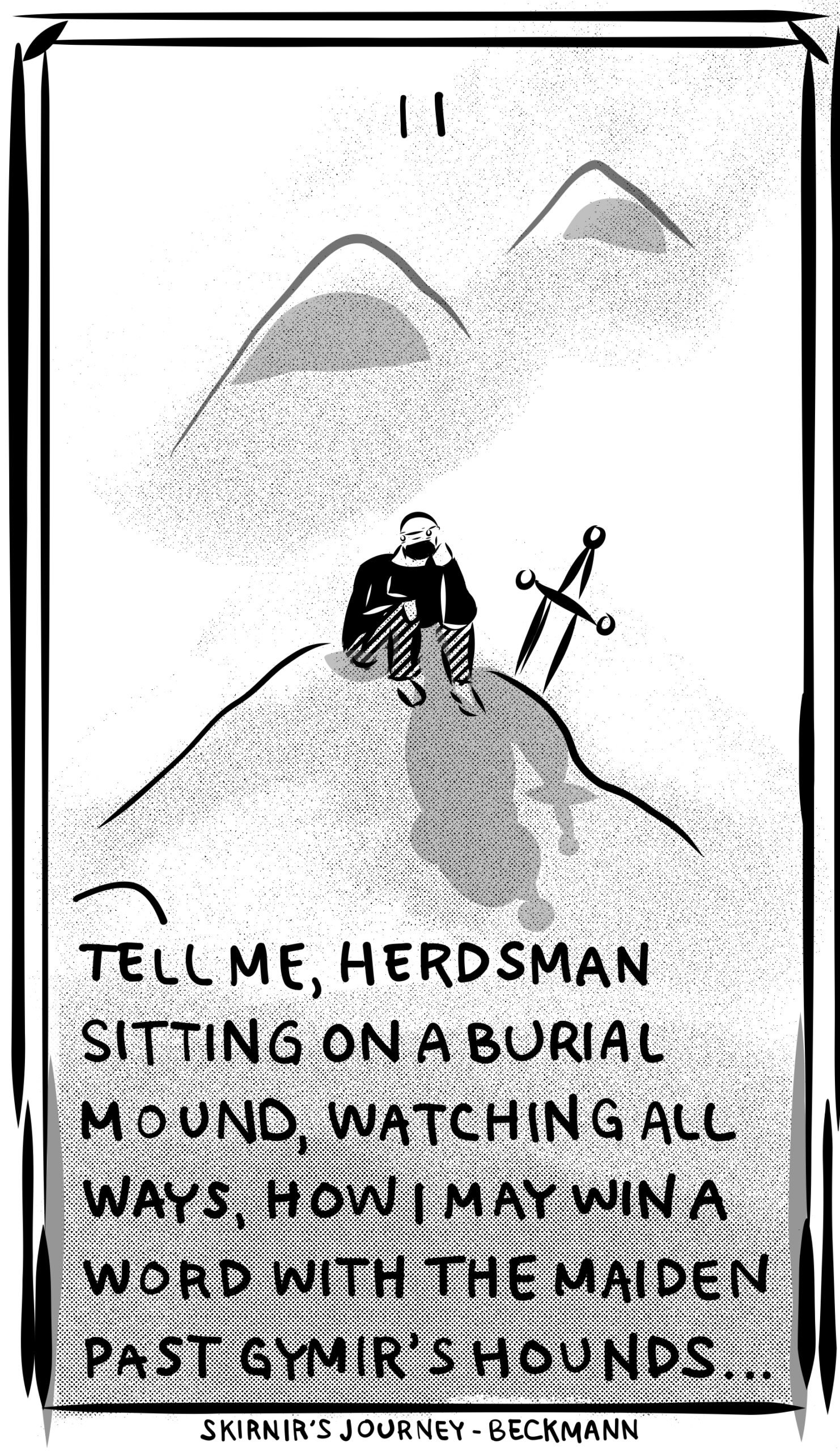
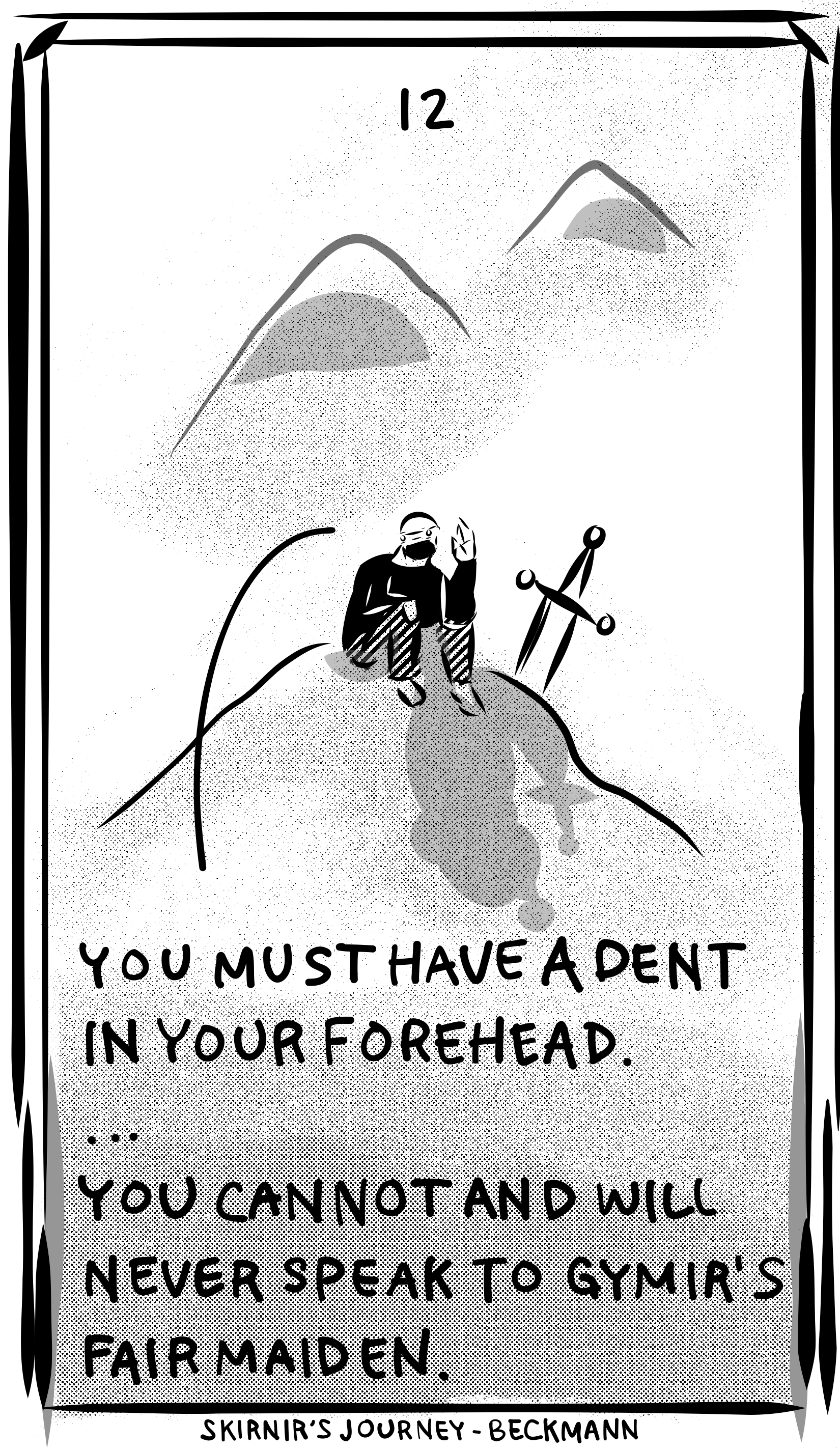
Sometimes our lives take unexpected paths…
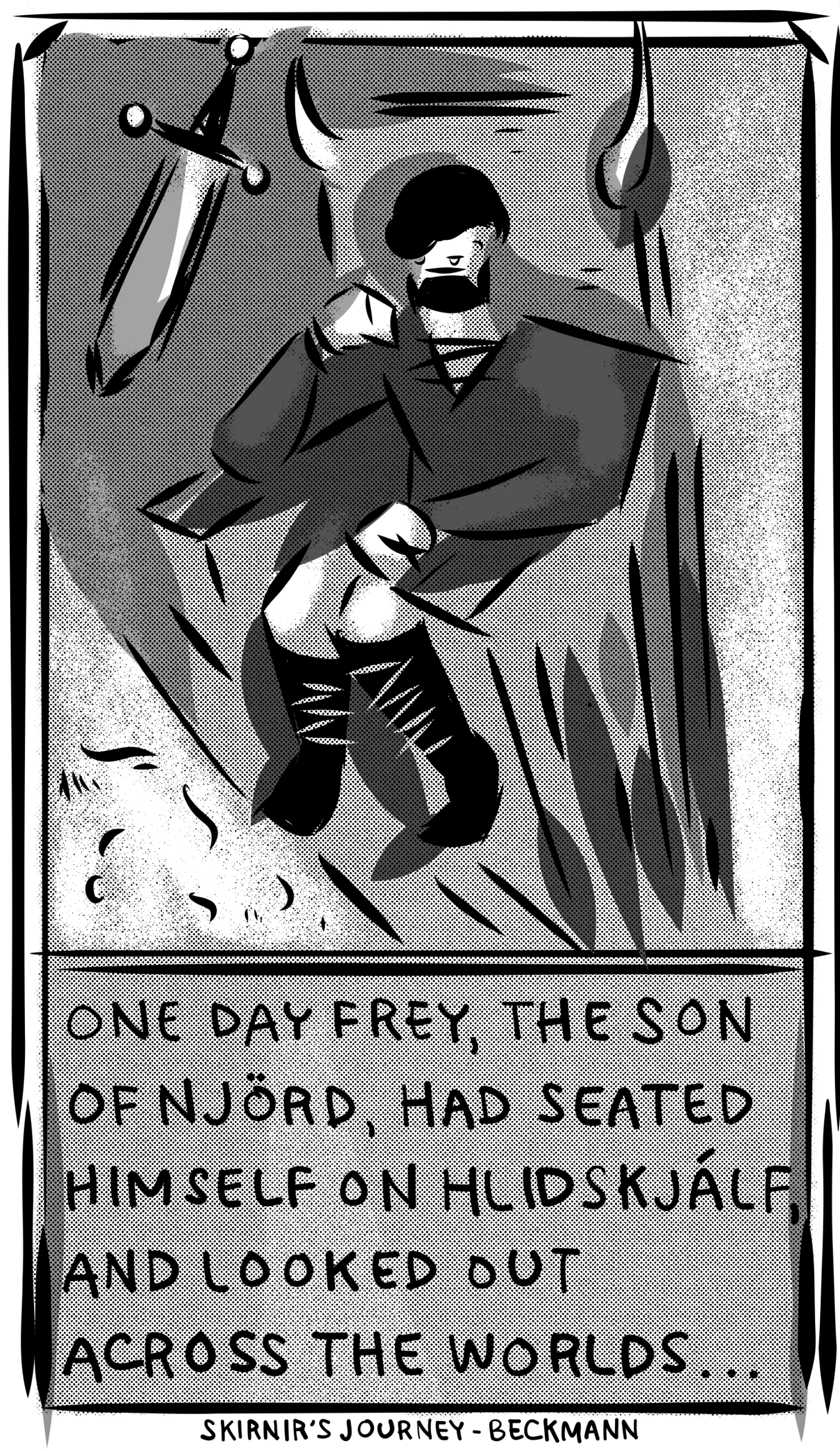
Skirnir’s Journey is a beautiful poem contained within the Codex Regius (King’s Book, i.e., the book containing the original copy of Havamal; purportedly Odin’s direct words). Skirnir’s Journey predates the Codex Regius, which was written around 1270; we know this because Snorri writes about Skirnir’s Journey ~50 years prior to the Codex Regius’ emergence. Scholars estimate its origins around 900 AD, but I bet the lore dates to far earlier, near Odin’s time around 300 AD. The poem speaks of breeding with giants. It’s like a Norse Nephilim tale and contains a history of the origins of one of the Swedish king’s lines that Odin precedes, but is not directly related to. Odin (Aesir clan) first unifies and rules Sweden, but the ruling line passes to others descended of Freyr (Vanir clan). Skirnir’s Journey occurs just after the Aesir-Vanir war was settled by truce. Hostages were exchanged. Mimir (Odin’s mentor) is the Aesir hostage exchanged to Vanir. His fate is terrible and the Vanir cut off his head in a break of the truce. Freyr is a hostage exchanged from Vanir to Aesir, and usurps Odin’s throne after his death. Freyr is called the wise one – which is a weird name to use, given that Odin is traditionally seen as the All Wise. Freyr seems to be depressed in his new setting and sits (without rights) in Odin’s chair. It’s a poem mocking Vanir usurpers of Odin’s rightful throne.
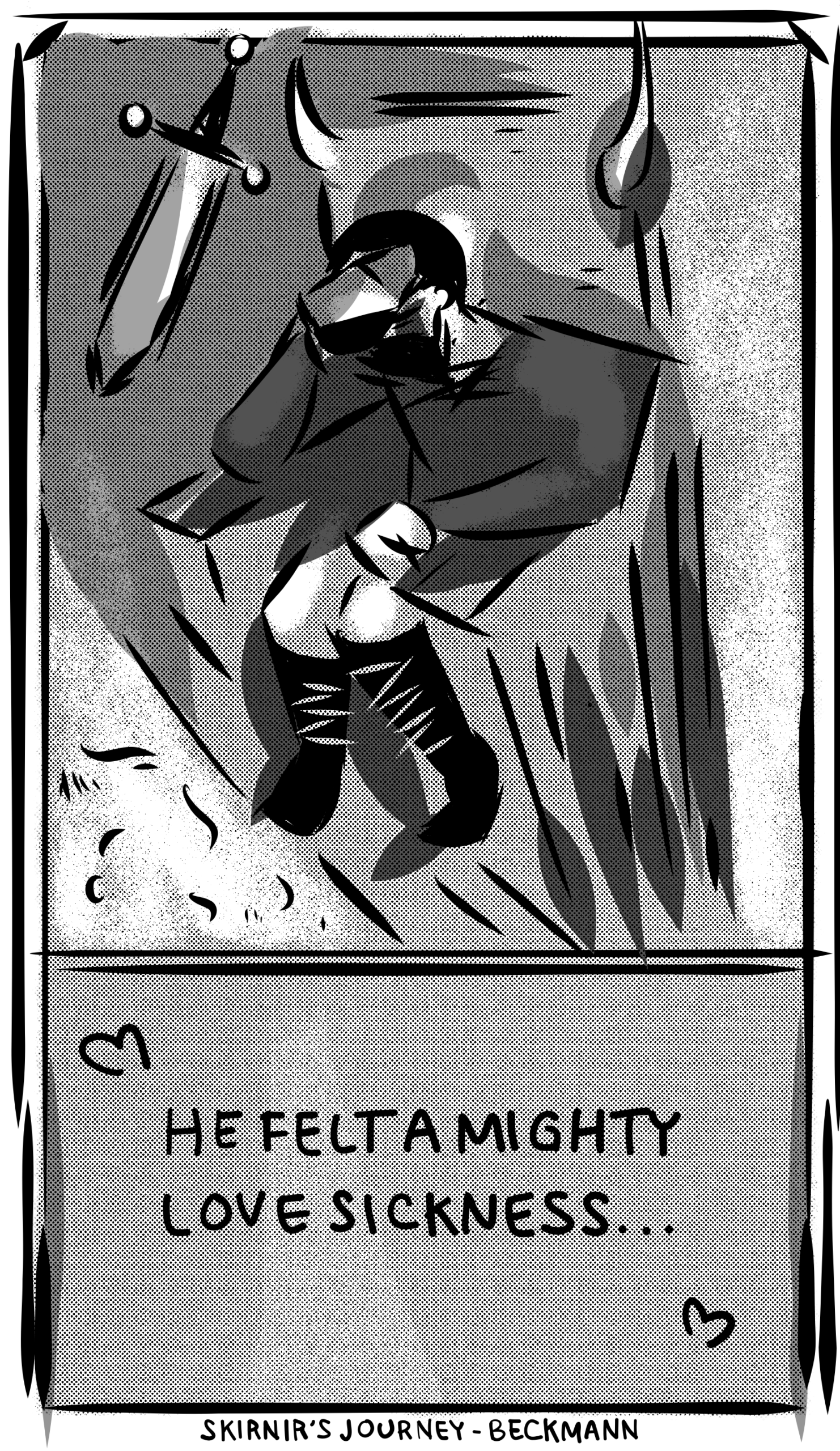
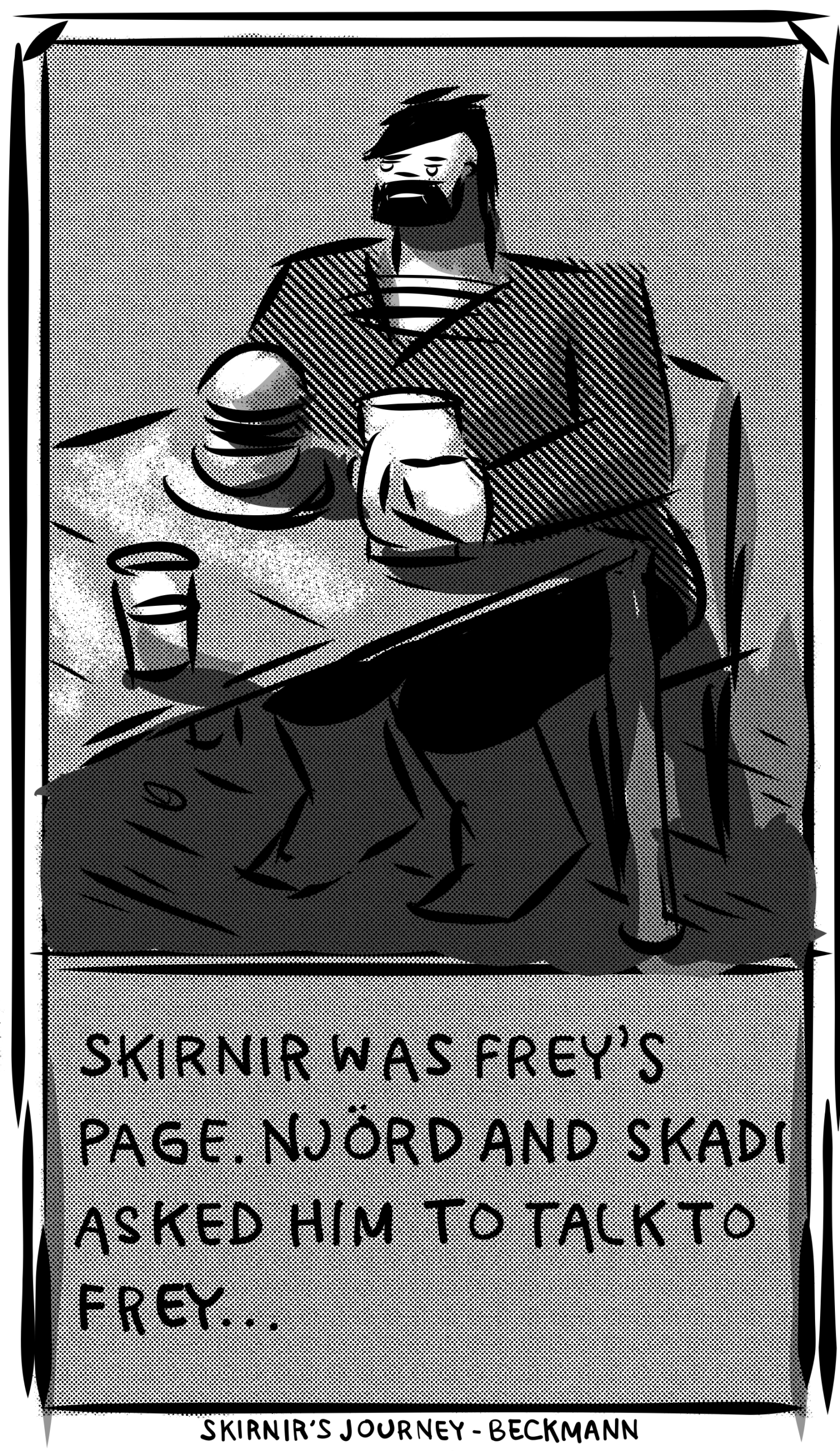
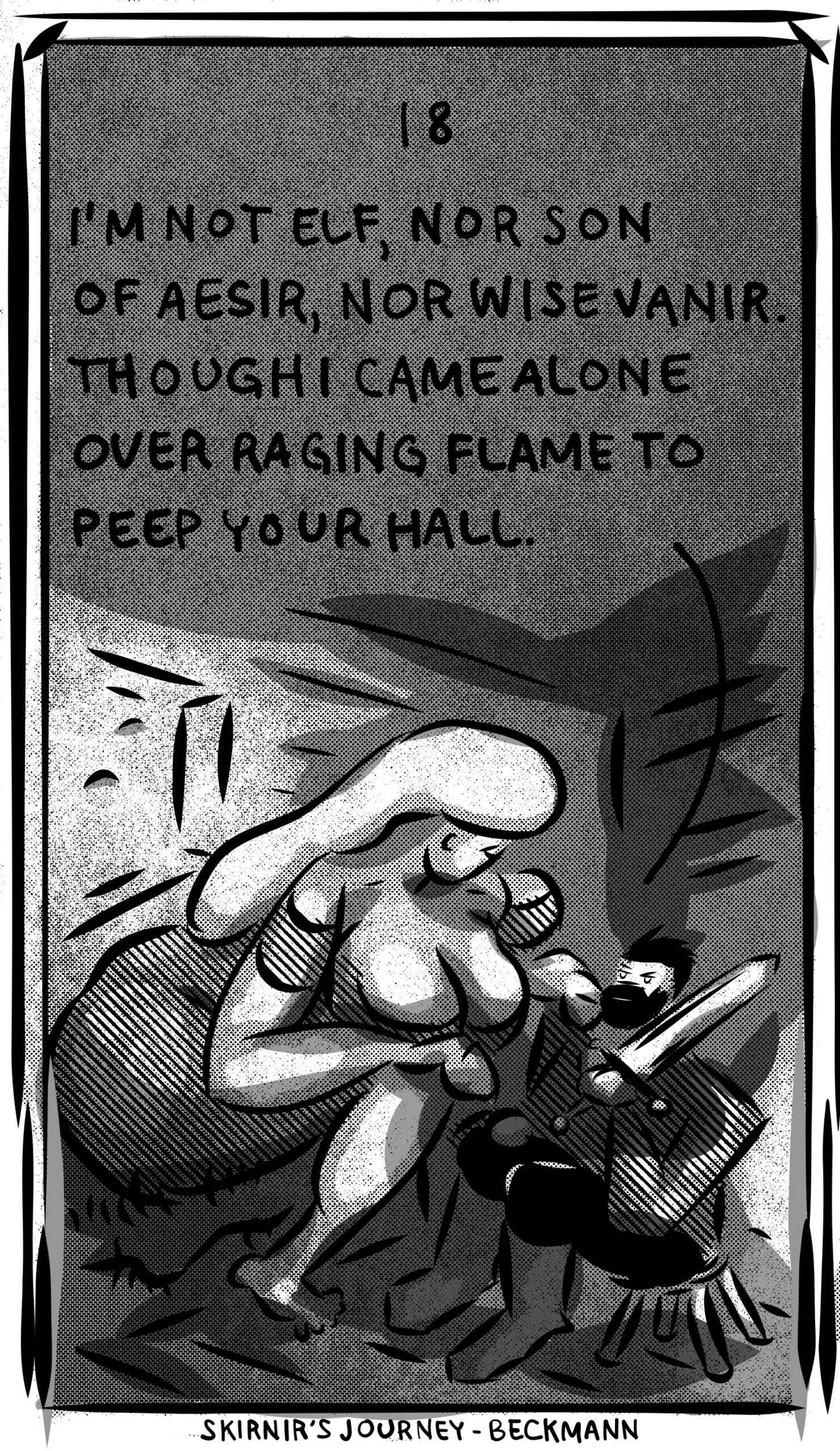
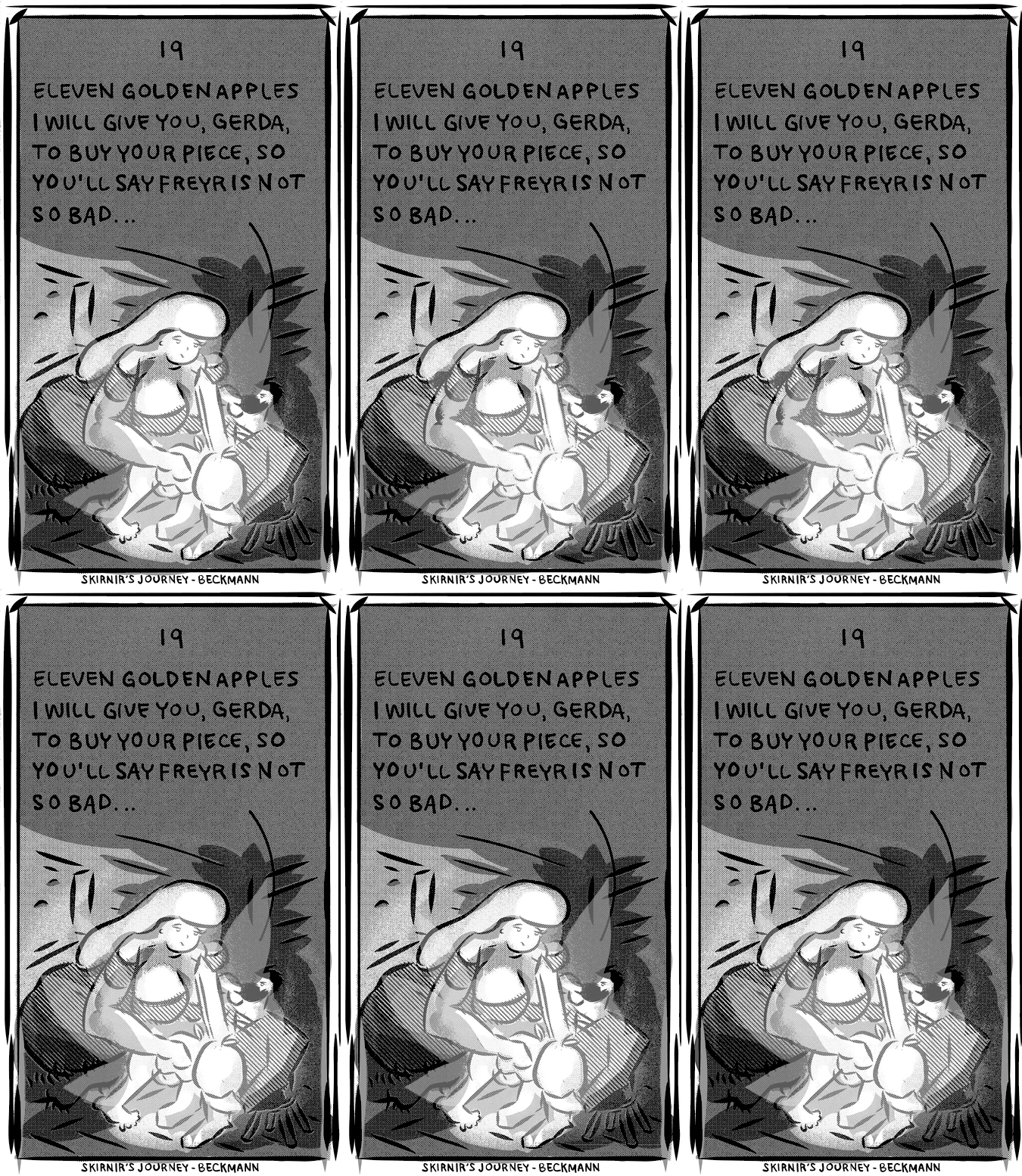
It’s implied that the Vanir are degenerates that were skilled at witchcraft and could not be defeated. They represent Odin’s only recorded truce; a truce that costs him his throne. They are a line descended from outright incest (Ynglinga Saga). Notably, the poem shows how Freyr sends Skirnir to do the hard noble work in his place, rather than taking on the noble quest himself. Often this is interpreted as him being love-sick, but my reading of the poem implies that he is a sissy or a dandy. In stanza 19 Skirnir literally asks Gerda to simply agree that Freyr is maybe not the worst man alive… In contrast, Skirnir is the hero here. Skirnir is clearly a commoner. He specifically says he’s neither Aesir nor Vanir (18). But he grew up as a servant of Freyr, so he could have grown up among Vanir and/or Aesir and was possibly given to Freyr after the hostage exchange or came with him. It’s not clear what he is, but there are some hints. He somehow possesses Odin’s magical arm ring, Draupnir. Draupnir has a long story arc itself that I won’t detail here. My interpretation is that this is a sign that Skirnir is Odinson. He belongs to Odin.
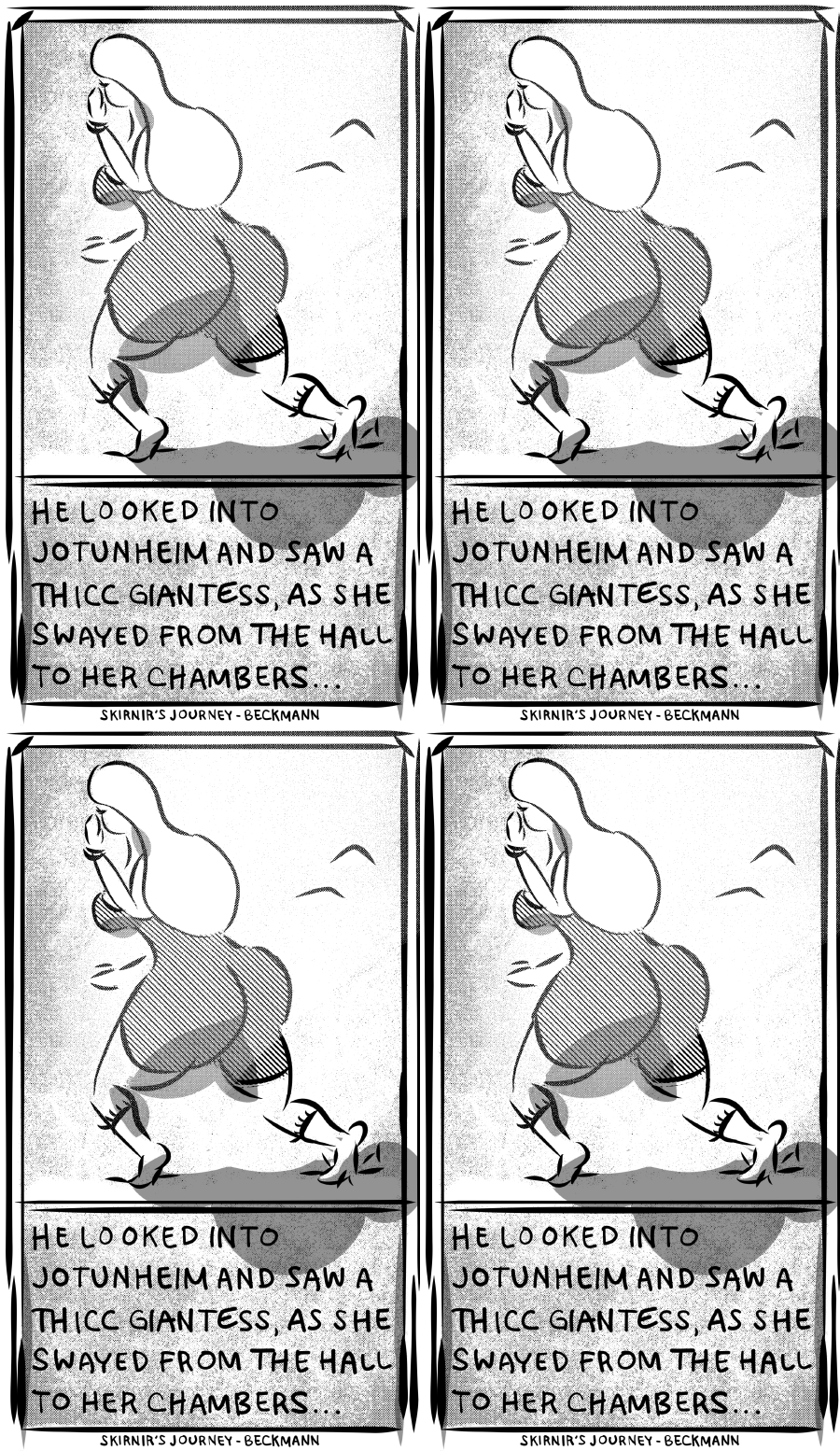
The Jotunn are a third race clan here, the frost giants. Odin implies the Jotunn men are evil, but the Aesir keep finding themselves in weird situations where they want to breed with Jotunn females. Both Havamal and Skirnir’s Journey imply that giant men kill anyone on sight, unless you can trick them or drink with them. Aesir clearly fear Jotunn and want their powers. Thor tries to exterminate them whereas Odin, the wisest, tries to breed with them. Odin’s Havamal spends significant time detailing how he stole the song mead from the Jotunn by seducing their women. Odin himself is half Jotunn, so they are like a weird outgroup that everyone loves to cross into. Saxo details how the interbreeding created a line that shared good properties of both (described in my prior essay on Havamal). Havamal explores Aesir-Jotunn interbreeding and Skirnir’s Journey echoes or counters with Vanir-Jotunn interbreeding. Both clans want to historically document in lore how they are interbred with the Jotunn outgroup. Norse lore seems to always center around these bizarre eugenic interbreeding schemes among various Nephilim clans.
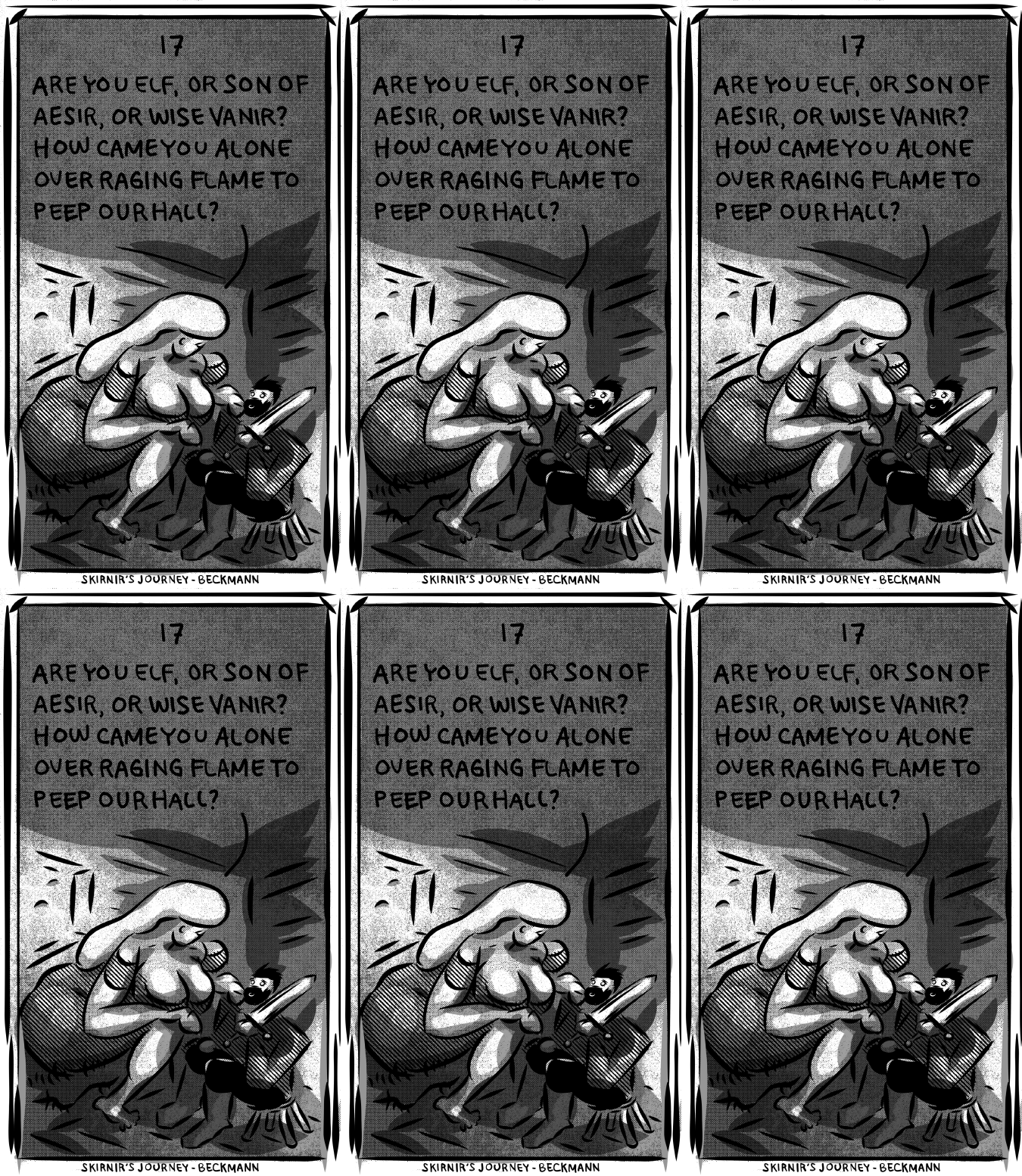
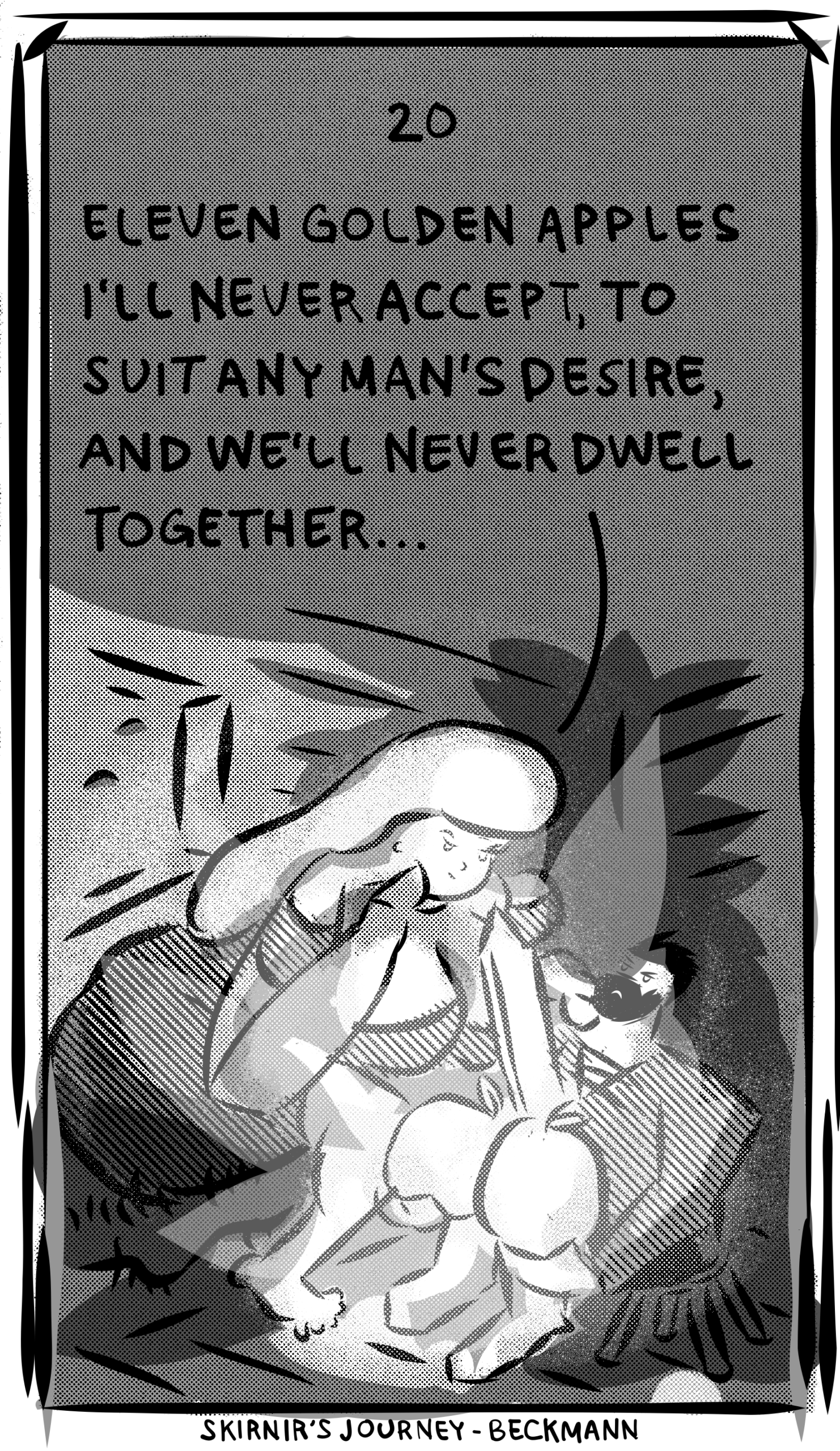
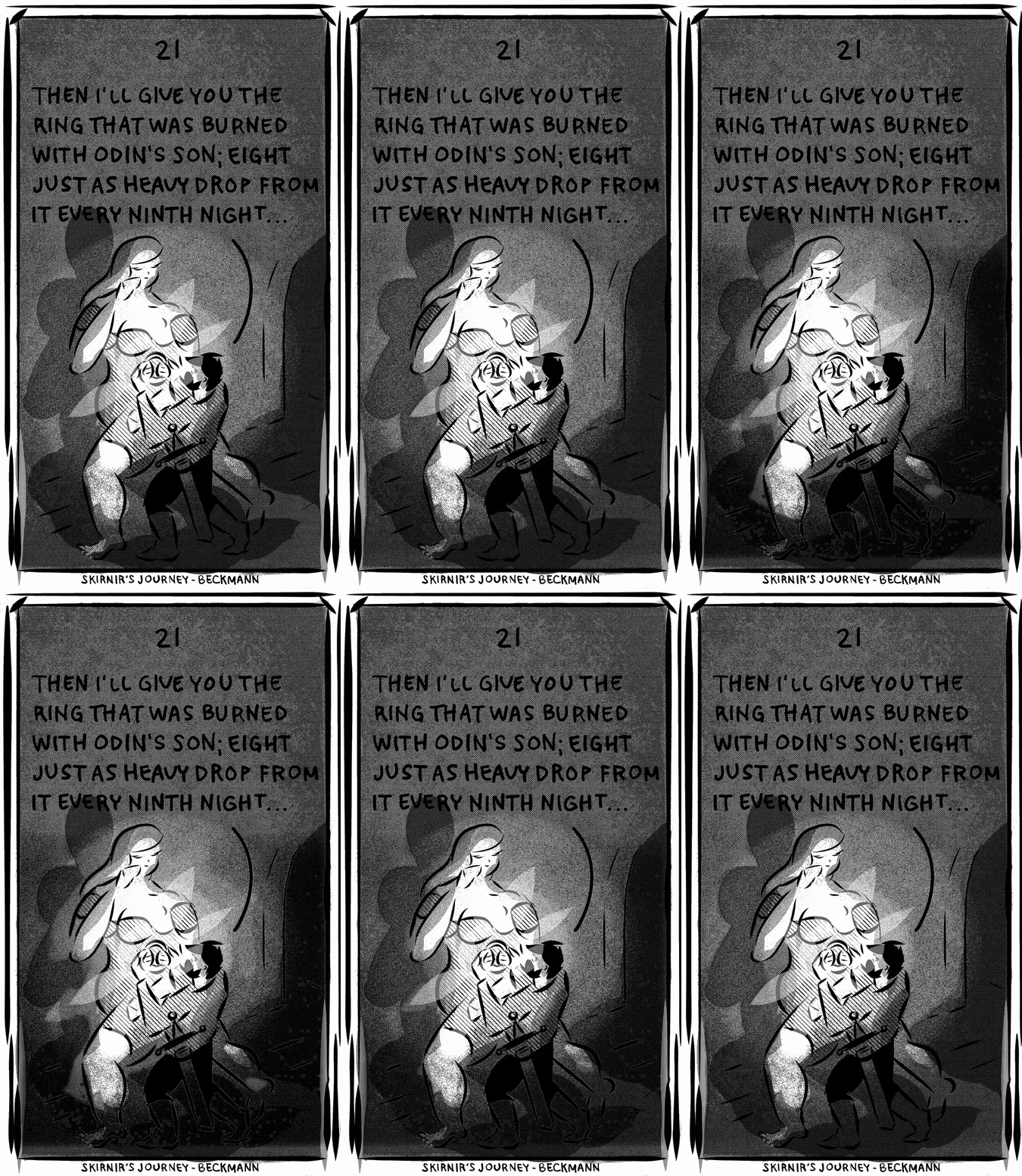
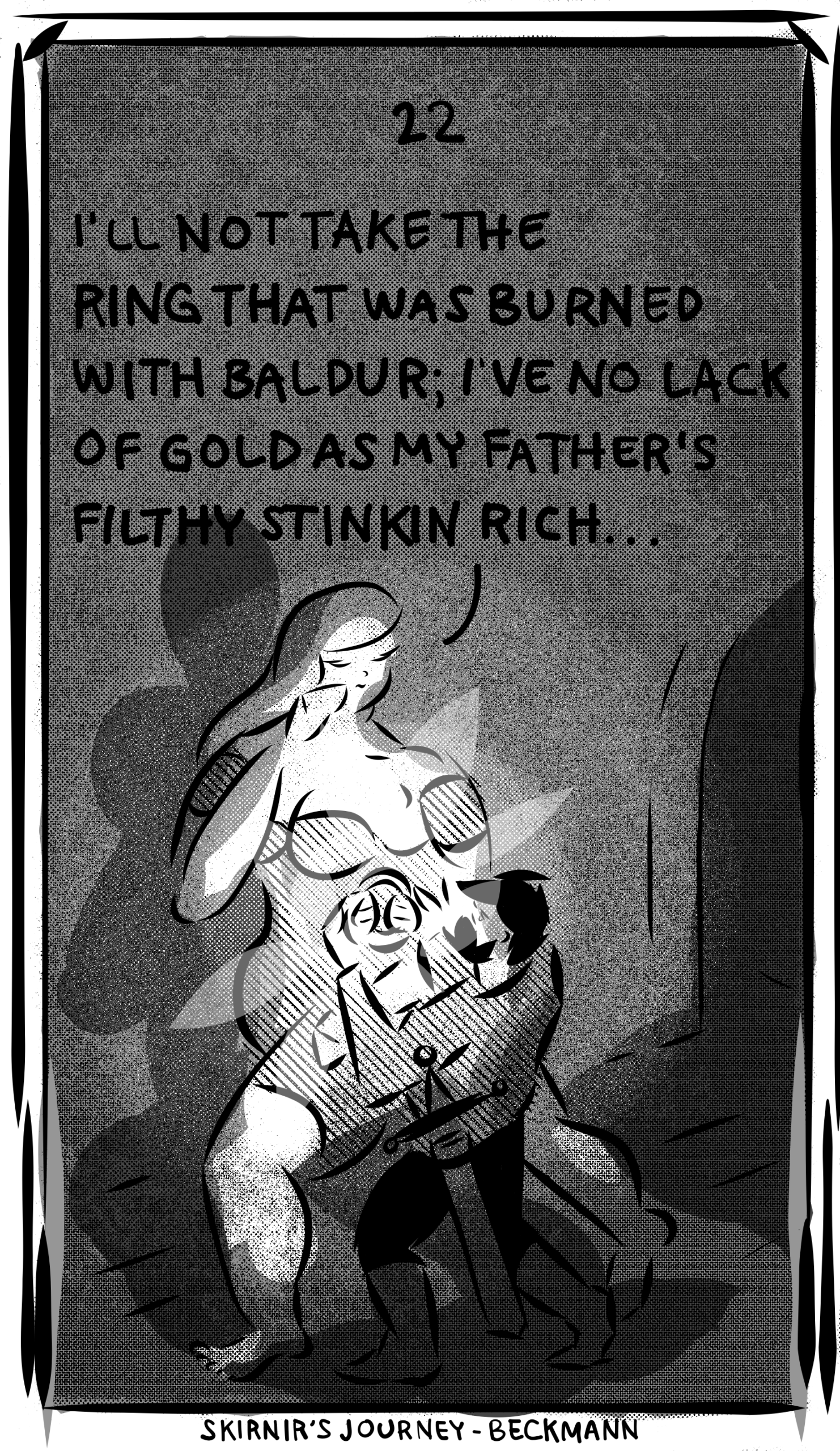
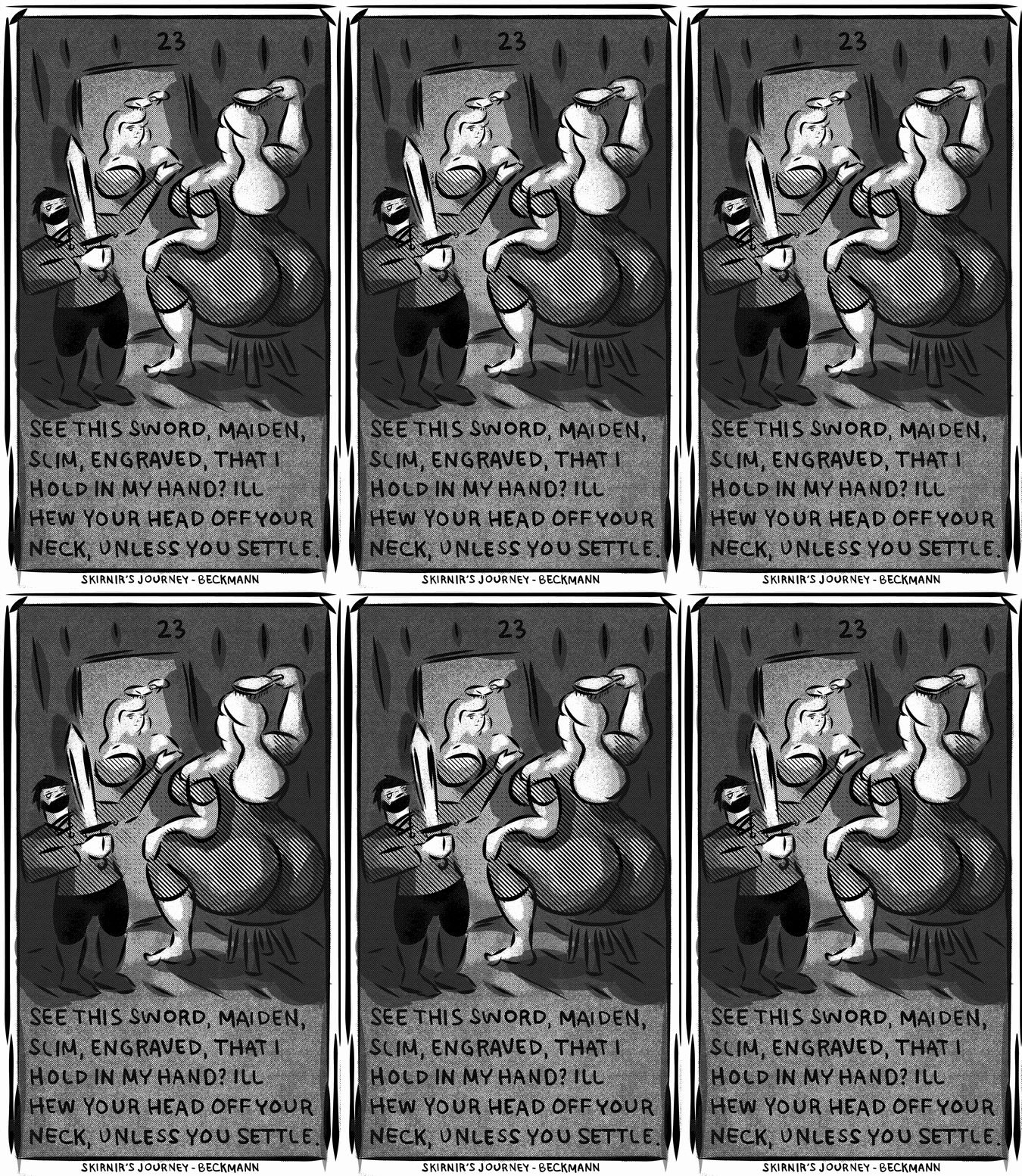
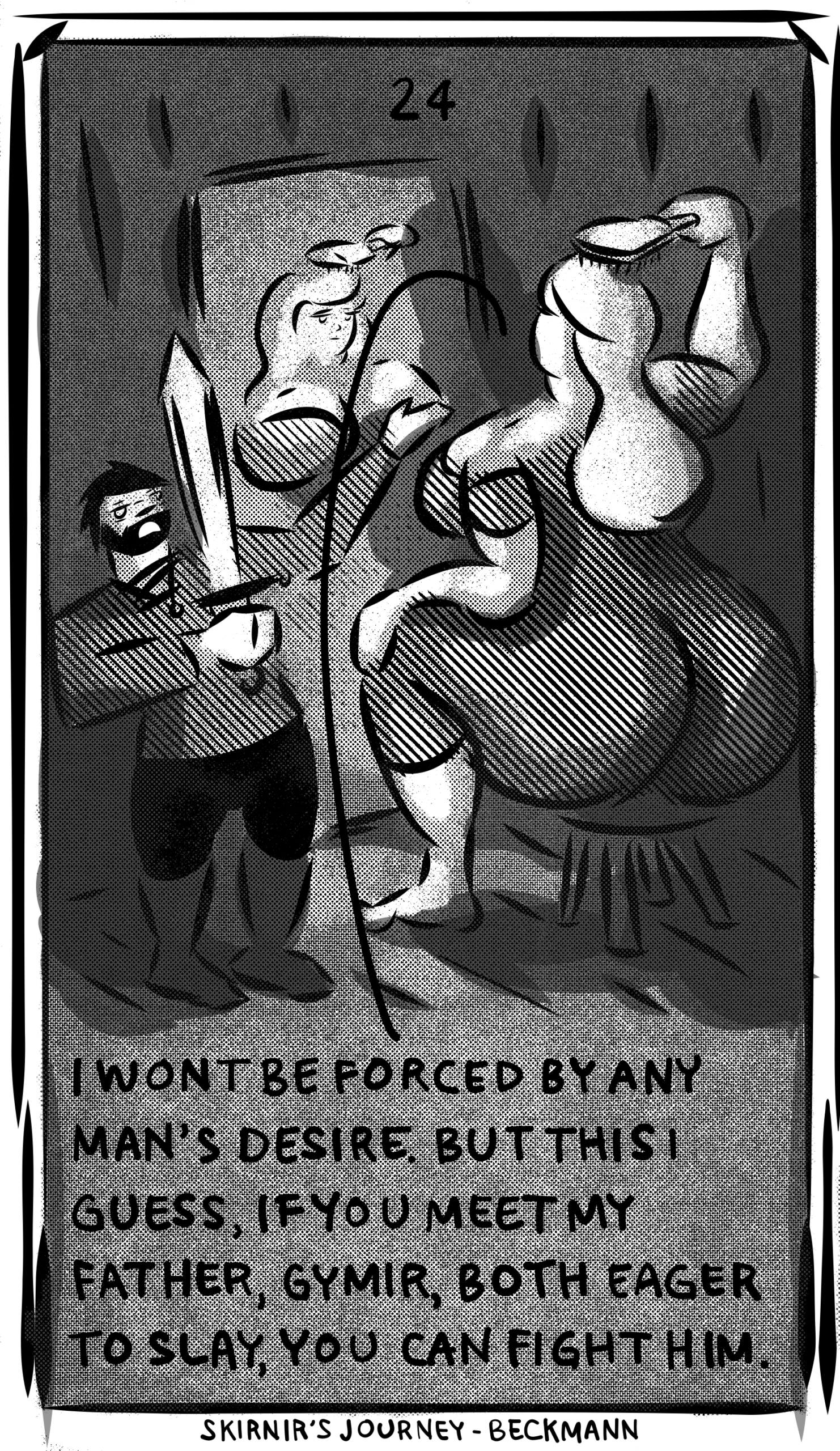
To restate, the real heroes here are Skirnir (the commoner, or the man with no lineage, with the strength of will to act) and the mysterious sword that fights autonomously, if the owner is wise. Skirnir is placed in essentially an impossible situation. He has to go alone into a non-permissive environment, approach or storm a giant king’s great hall, steal or convince the king’s daughter to be elope and breed with a less than worthy prince of another clan (essentially against her wishes). The poem is also a humorous reflection on Norse women’s natures. From the male perspective, nothing can ever satisfy or please them enough. Gerda is offered eleven golden apples (some translations imply these are magical apples that grant eternal life), a self-replicating golden ring derived from Odin himself (Draupnir), which she also refuses; then later Skirnir resorts to threatening to kill her. Nothing sways her. Only when she is cursed in written runes—Níð, pronounced neeth, a form of memetic magic that Odin specializes in—does she relent. Níð magic is akin to a dark persuasive art where you publicly shame people to change their behavior or challenge their honor. It’s a form of dark persuasion.
Why is Gerda so recalcitrant? In Norse culture the women have lethal standards and would compete for men by making them do arduous heroic tasks that put their lives in great danger; In Deeds of the Danes, Saxo claims Ragnar’s wife, Lagertha, only agrees to marry him after she herself baits a bear and places a hound outside her house; he must fight and kill both to win her. His other wife makes him kill a giant venomous serpent. In Njal’s Saga and Saga of the Greenlanders the women force the men to murder each other. If they are killed, then I guess they were not meritorious enough to live with these picky women… They used mate selection to select for lethality.
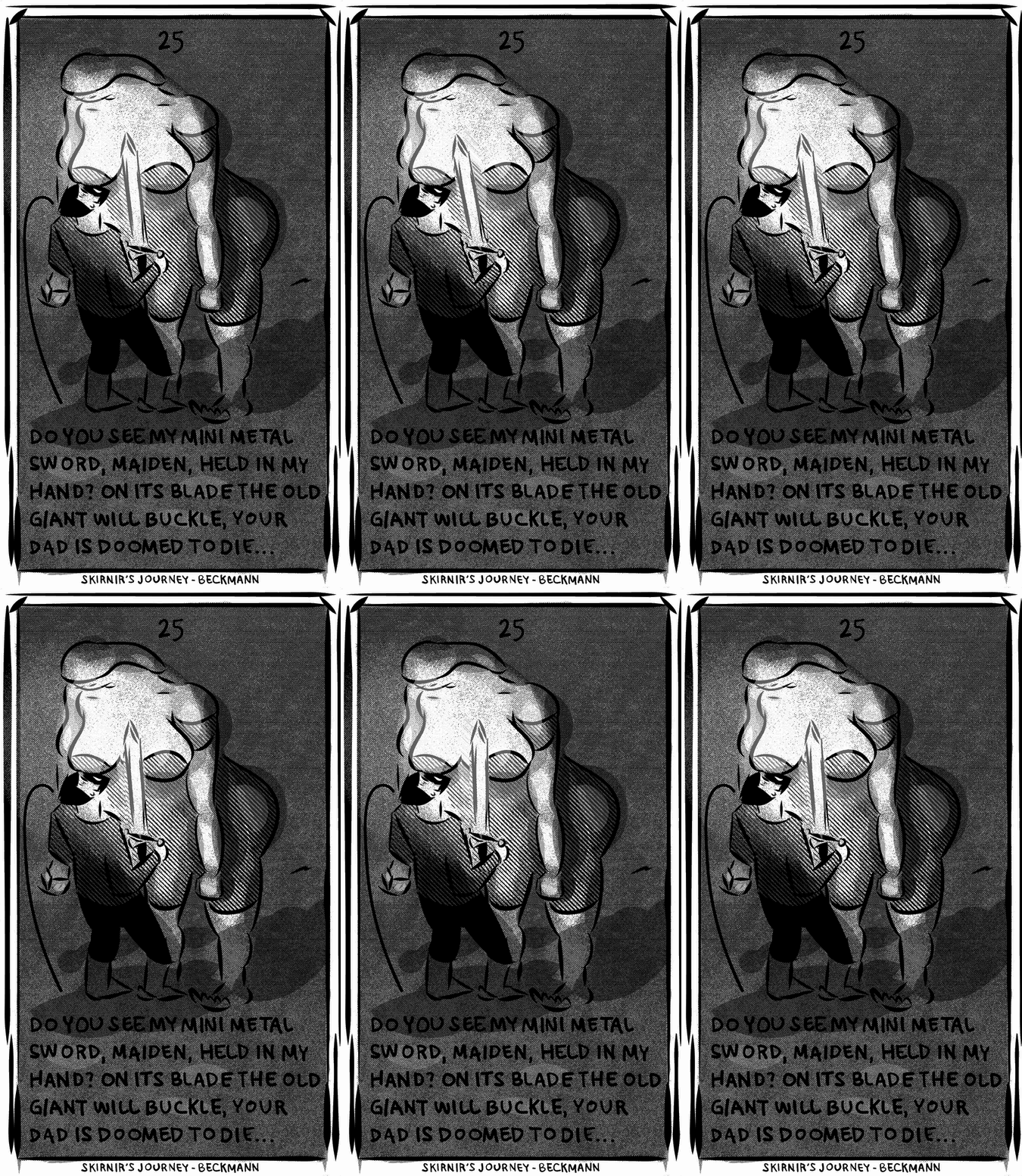
Thus, Skirnir faces this impossible task, to win a woman, for someone else! He is a hero and the poem implies that the sword does the fighting for him (showing he is the wisest one, possibly a secondary confirmation he is Odinson). One stanza proves this and its worth describing and discussing the translation process, pertaining to this point:
Gerðr kvað:
14. “Hvat er þat hlym hlymja, er ek heyri nú til
ossum rönnum í?
Jörð bifask, en allir fyrir
skjalfa garðar Gymis.”
This translates roughly to something like:
Gerda said:
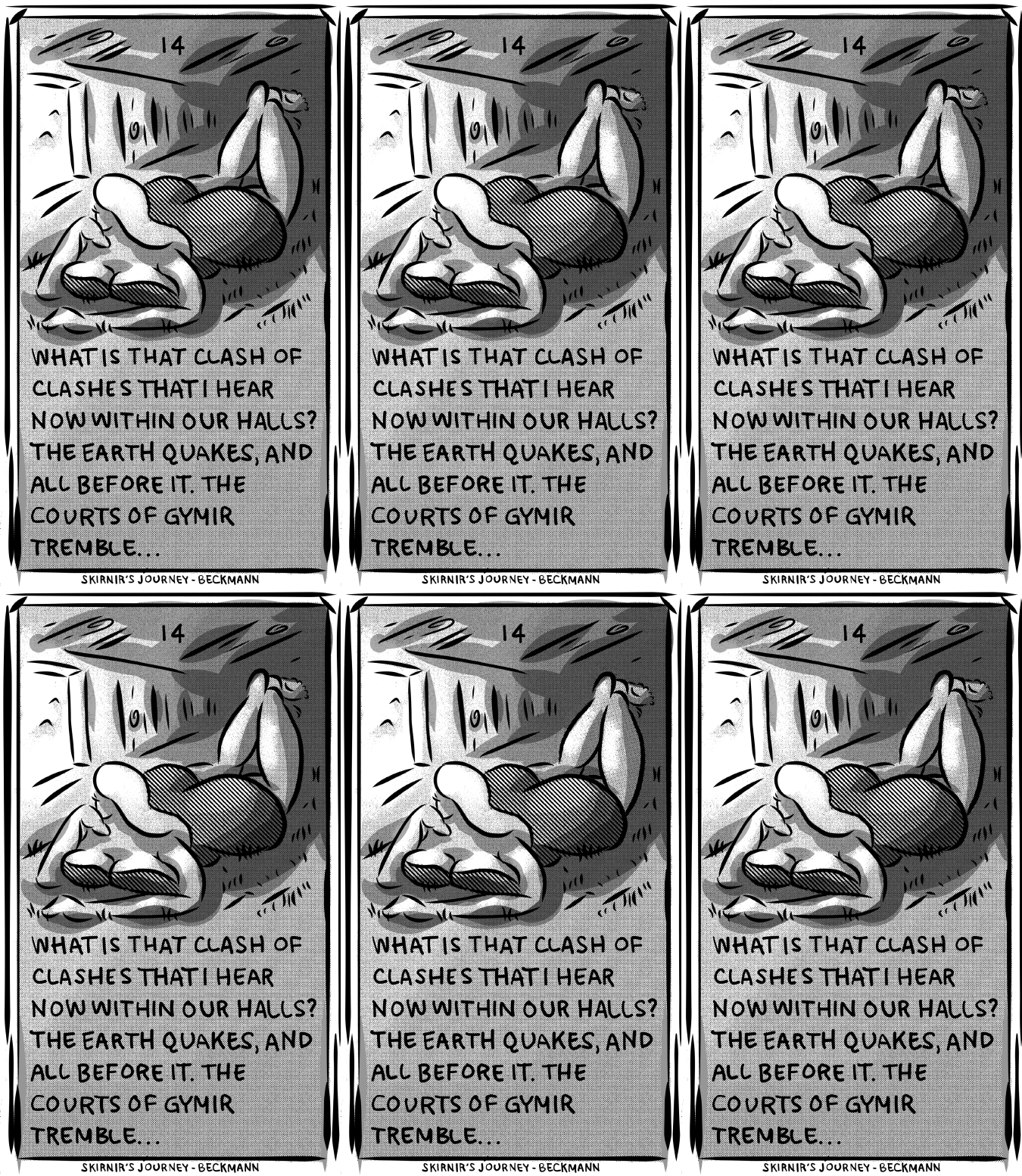
14. “What is that clash of clashes that I hear now
within our halls?
The earth quakes, and all before it.
The courts of Gymir tremble.”
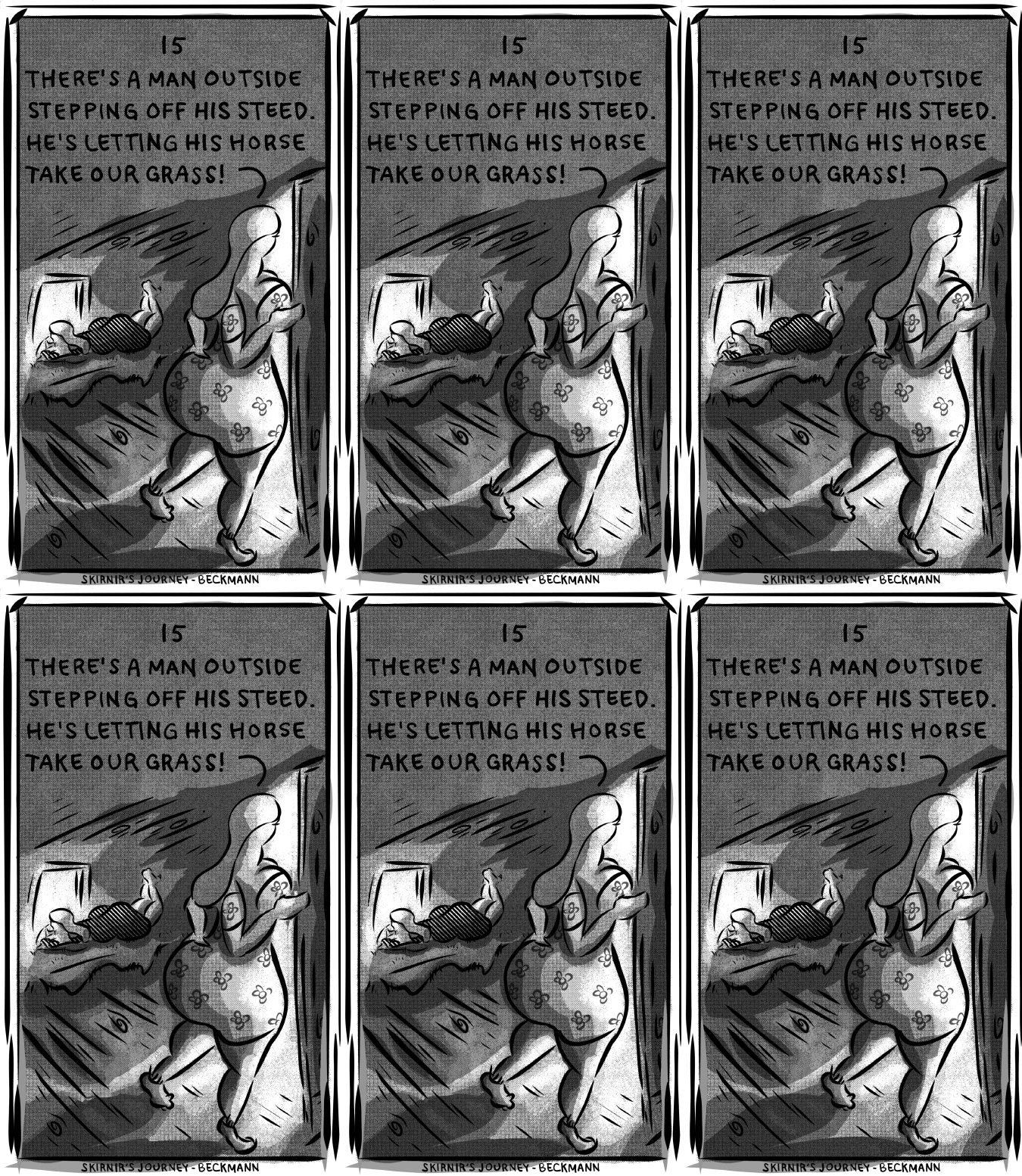
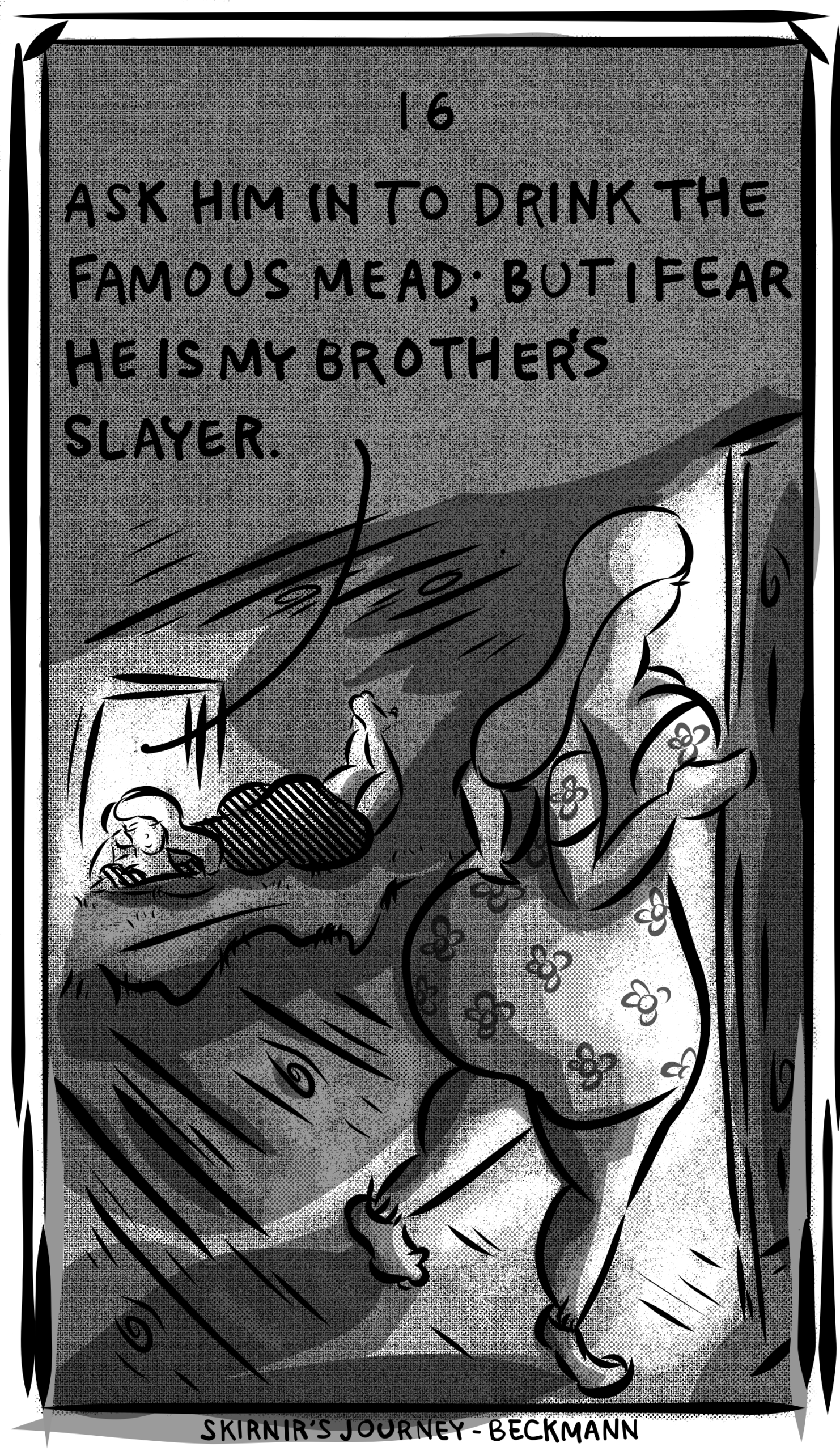
I chose clash of clashes here because the poem makes a rhyme at “hlym hlymja.” This is like a sound of sounds, a clamor, or a “clash of clashes.” Other translations use strange words like din (which makes no sense to me). The word choice is important here because it implies what is happening outside. Gerda hears fighting outside. Skirnir is breaching or storming into the inner sanctum outside the hall and Gerda hears it and asks what is happening. That’s how he wins a word with her, only by causing a commotion does he spark her interest. So, he gets lucky after making a bold move that was likely to fail at his own peril. This stanza further implies the sword is fighting for him if you believe in magic, and they did (but it’s not written out in detail). Or it implies that he is a master swordsman himself. Thus, this stanza confirms Skirnir is the hero of the poem.
The sword is not recovered again in Norse lore and it’s implied that Skirnir gets to keep it; but Freyr the degenerate gets a nasty end at Ragnarok when he is forced to fight without a sword against Surtr, a fire Jotunn (not all are frost). It’s a joke that he gave up his powerful autonomous sword to have another woo a woman for him (and Loki mocks him for it in Lokasenna) – perhaps he was not wise… and Aesir calling him “the wise one” is more like sarcasm. The poem is both a warning about Norse women and a subtle suggestion that perhaps the sacrifice was worth it; the sacrifice of the sword or of Freyr? The Norse leave much up to interpretation and don’t spell out every detail. “Always say less than necessary.”